
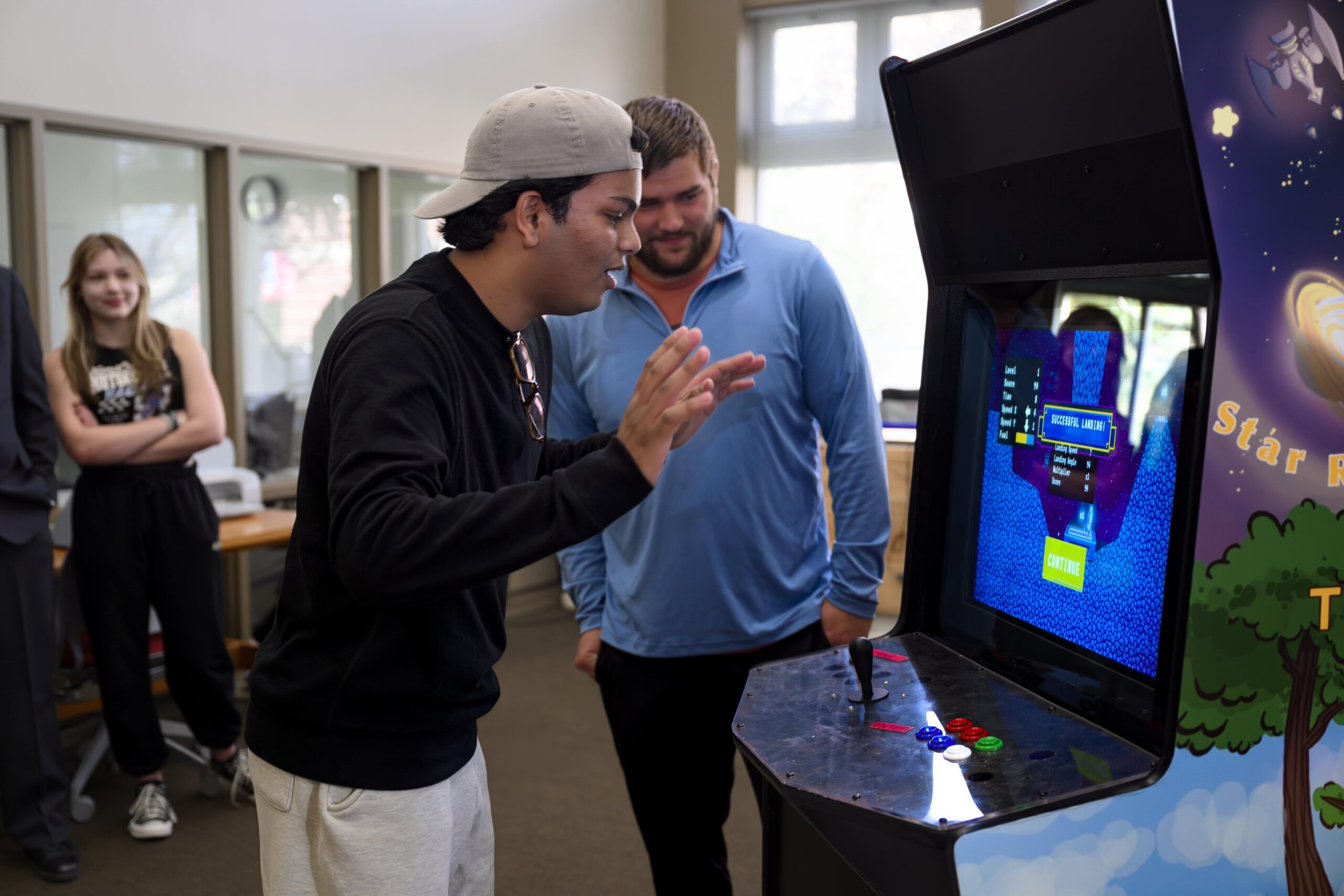
Video game development is one of the career paths Henry Dipeolu hopes to explore in the future.
And there’s no better way to understand that field than by taking a game from concept to a finished product ready to play in an arcade format.
That’s exactly what Dipeolu and the 22 other students in Professor Srikanth Vemula’s Computer Science (CSCI) 3170 class at the College of Saint Benedict and Saint John’s University have done this semester— gaining hands-on experience with the entire development process along the way.
The course gave students hands-on experience with the full game development process, from initial idea to final product. They learned how to turn creative concepts into working software while balancing ambition with technical feasibility.
Through team-based projects, students developed collaboration, communication and problem-solving skills while navigating bugs and design challenges. The class also emphasized real-world practices such as iterative testing, project management and cross-disciplinary collaboration, providing a deeper understanding of how large software projects evolve.
“It’s really exciting to get the chance to be part of this,” said Dipeolu, a sophomore computer science major at SJU. “It’s almost been like watching a child grow — from coming up with an idea, to programming it, to testing it and finally seeing the finished product. It’s been a rewarding and satisfying experience.
“Something might seem like a great idea in your head, but you have to figure out if it’s actually possible,” he continued. “There’s a lot of trial and testing involved.”
That’s precisely the takeaway Vemula was hoping for. Having previously worked in the video game industry, he wanted to give students insight into what the development process looks like in a professional studio while helping them build skills that extend beyond game design.
“They go through the ideation process, develop concepts, then solve problems as they begin programming, test their work and return to refine it,” he said. “They also learn how to collaborate and work as a team. Testing doesn’t always go as planned, so they develop patience and adaptability as well.
“It’s not just about having a cool idea. They’re seeing how much work is required to make something like this happen. This same process applies to any kind of software development — there are many steps from start to finish.”
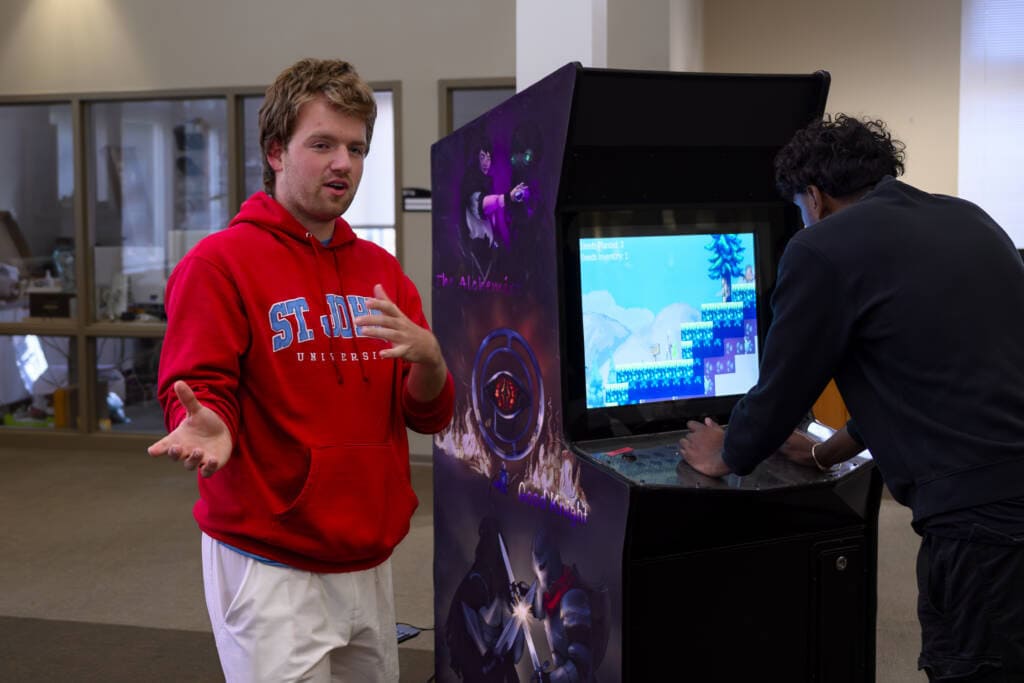 Photo by Tom Morris ’89
The course — titled “Video Game Development” — was first offered in 2024. However, during its initial run students created games that could only be played on their computers.
This time, Vemula had a bigger vision — one that included cross-campus collaboration.
Students partnered with members of the CSB and SJU art department, including Livia Schwartz and Isabel Bohlsen (both student employees in the Clemens Library Makerspace Lab at CSB) to design artwork. One team also collaborated with music major Bernie Noria-Castillo to compose a soundtrack.
Adam Konczewski from Instructional Technology assisted with project management.
Perhaps most impressively, after an old arcade cabinet was discovered in a basement in nearby Avon, Makerspace literacy librarian Bennett Frensko, along with Makerspace student employees and Colin Jarrel of Fine Arts Programming, refurbished it.
All nine student-developed games were then installed, making them playable in an authentic arcade format.
“It feels very old school,” said SJU sophomore Shamin Fazal, who worked with Dipeolu and fellow sophomore Colton Hern to develop a game called Star Runner. “It brings me back to the 1970s and ’80s, when arcade games were at their peak.”
“It’s really cool to see our game in this format,” Dipeolu added. “It’s like cooking something for the first time and finally getting to taste it—you realize, ‘Wow, I made this!’ So much effort went into it, and now we get to see the results.”
The arcade cabinet will have a permanent home in Clemens Library, giving visitors the chance to play the games for years to come — no quarters required.
“This gives us an opportunity to showcase our students’ work, which is always exciting,” said science, health sciences and data literacy librarian Kara Schleck, who helped secure game concepts and copyrights. “It also helps bring students into the library in a fun and engaging way.
“We don’t want this to be just a place for studying. We want it to be a space where students can take part in activities they enjoy.”
Students were initially divided into teams of three, although two chose to work independently — further strengthening their ability to manage complex projects either collaboratively or on their own.
“I had never designed a game before,” said Nasir Mirza, a junior computer science major who created a game where players must safely land rockets on different terrain. “But (Vemula) gave us a lot of guidance on how to get started, which made a big difference.
“It’s been a great experience that taught me how the entire process works.”
The experience has also given students greater confidence as they consider their future careers.
“With what I’ve learned, pursuing game development now feels very possible,” Hern said. “At the same time, computer science offers a wide range of career options in 2026.
“The skills we gained in this class apply to many different areas.”
“I’m at a point where I love computer science but am still deciding which direction to take,” Fazal added. “This class has taught us skills that are useful across the board, whether we go into game design or not.
“Project development skills will be valuable in everything we do moving forward.”
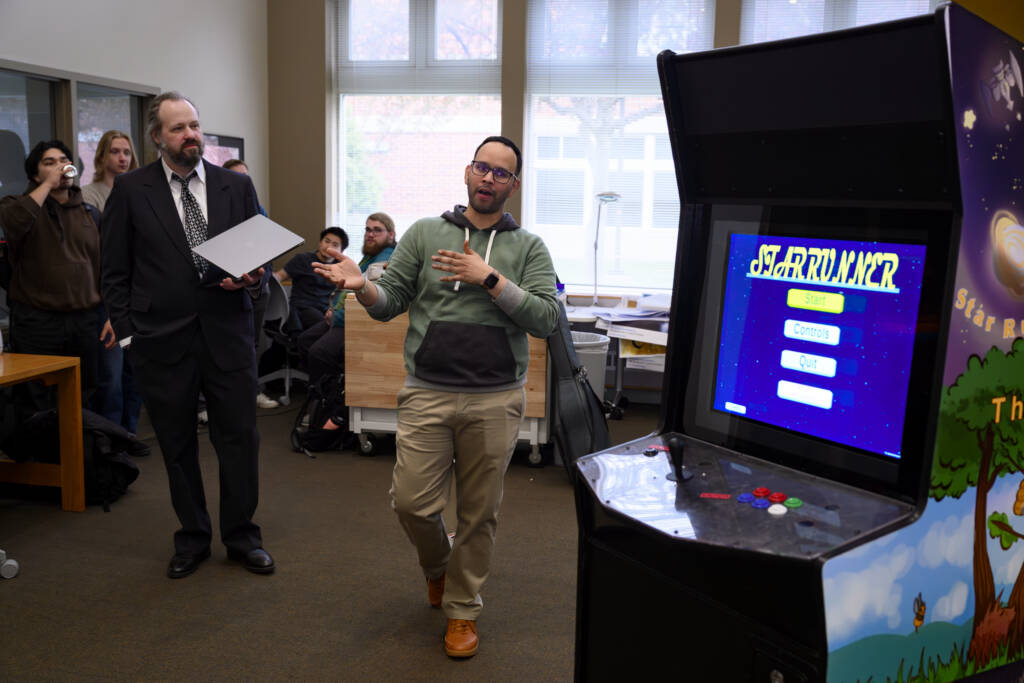 Photo by Tom Morris ’89