
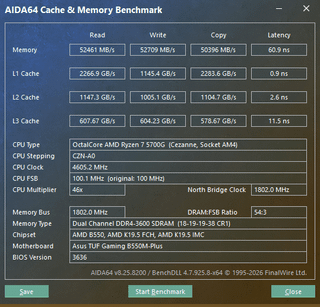
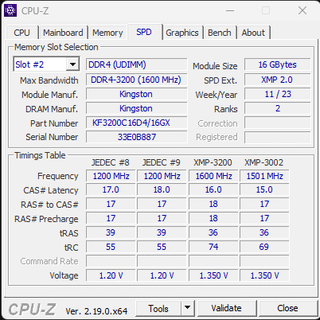
Kit: 2x16GB Kingston Fury Beast RGB (3200MT/s CL16 1.35v – Samsung C-die).
I'm following up on my previous post regarding stability issues with this kit: Previous post here. After some more testing, I finally found the solution.
While trying to find the ideal VSOC, I discovered that my inconsistent performance, stuttering (even with tRFC at 468), and cold boot issues were actually caused by ProcODT.
Initially, increasing tRFC to 477 stopped the stutters, but the "cold boot" problem persisted. It wasn't exactly a cold boot failure, but at 40 Ohms, the system occasionally forced memory retraining. I could reproduce this by entering the BIOS and saving (F10) multiple times in a row—eventually, the training issue would trigger. I tried bumping RAM voltage to 1.27v with tRFC 468, but it made things worse: while stuttering seemed to disappear, I lost about 20 FPS in the Shadow of the Tomb Raider benchmark.
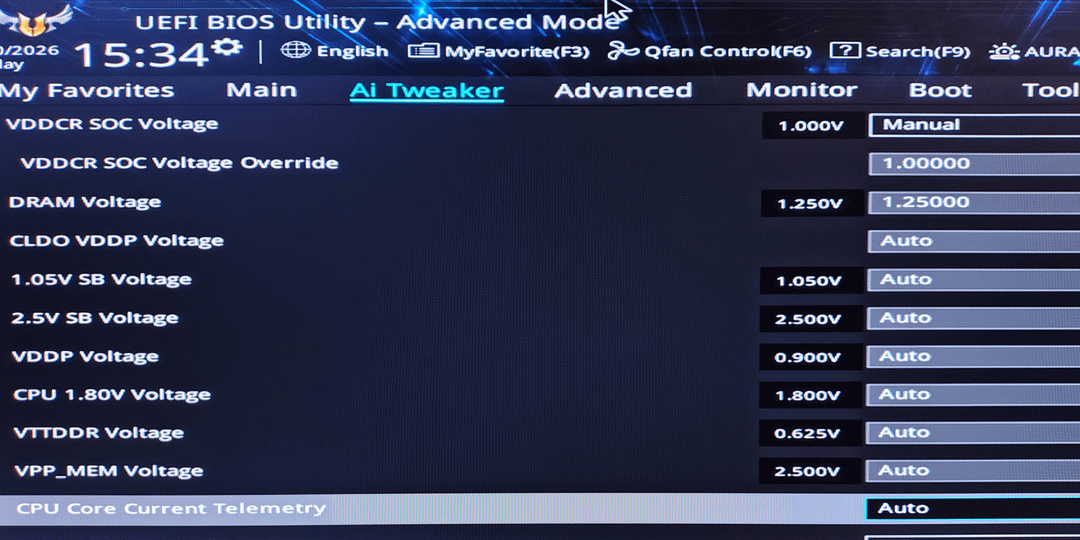
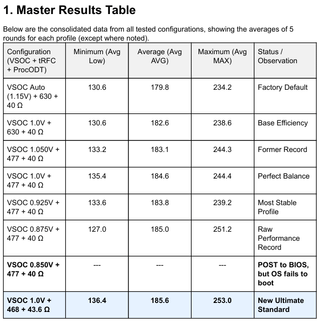
To find a baseline, I reset tRFC to Auto (630) and VSOC to Auto (1.15v). I then ran VSOC scaling tests (results in the images). I suspect I can run such low VSOC because my iGPU is disabled. Each voltage was tested over 5 rounds to calculate the average of minimums, averages, and maximums. While 5 rounds is the bare minimum, it provided a clear comparison. I used Gemini to help me calculate the averages and organize the data into a table.
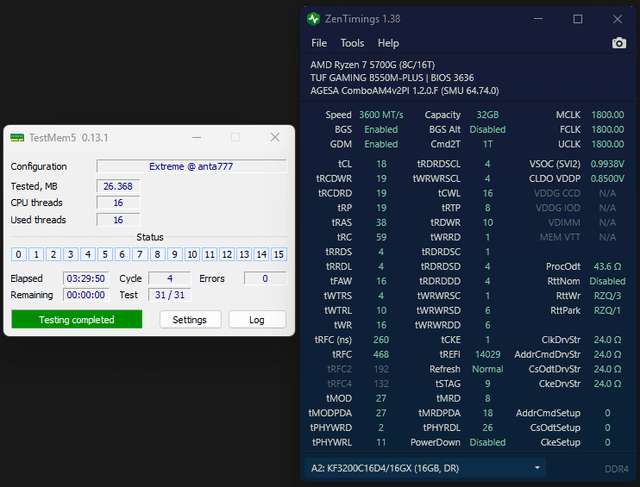
Rethinking the memory stability, I researched how ProcODT affects tuned timings. I increased ProcODT to 43.6 Ohms while keeping tRFC at 468 and began testing VDIMM:
1.23v: BIOS only.
1.24v: Threw errors in TM5.
1.25v: Rock solid. Passed 4 full cycles of TM5 Extreme in 3h 29m. Interestingly, my previous run at 40 Ohms / 1.26v took 3h 35m. The improved signal integrity from the higher ProcODT actually made the test finish faster. This completely solved the inconsistency at tRFC 468 and the retraining issues—even when repeatedly saving BIOS settings, it boots instantly without training.
It seems ProcODT at 40 Ohms works for 3600MT/s XMP/Stock, but tight tuning requires that extra bit of resistance.
Did I just get lucky with the silicon lottery here? This seems like an unusual result for Samsung C-die, but I’d love to hear how rare this actually is.