
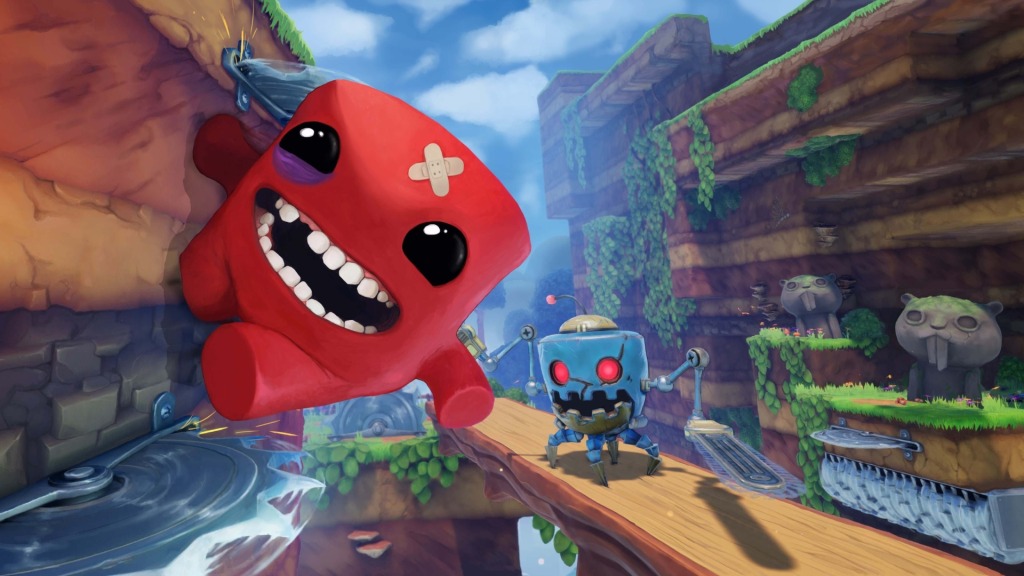
As anyone who’s ever absolutely wrecked themselves on Taco Bell’s endlessly Poochified menu of infinitely recombined ingredients knows, you can (at least temporarily) have a pretty good time doing something that’s objectively a bad idea. And while it’s not necessarily great that my mind, when trying to describe the experience of playing the recent Super Meat Boy 3D, immediately jumped to the crunchwrapification of my own gastrointestinal tract, it does feel apt. Because Super Meat Boy 3D is about as good an execution of a fundamentally bad idea as you could maybe hope to get.
The premise is right there in the name: Take 2010’s Super Meat Boy—a foundational indie platformer from Tommy Refenes and Edmund McMillen—and attempt to translate its sense of speed and gory precision into the world of three dimensions. And, from a strictly aesthetic point of view, developer Sluggerfly has done an amazing job of capturing the “Newgrounds cartoon come to life” look and feel of the original. The game, which sticks the titular Meat Boy and his various confederates in a hellscape of sawblades, burning acid, and increasingly devious platforming challenges—all backed up and empowered by the sounds of constant heavy metal guitars—successfully brought me back to my grad school days of feverishly ignoring course work so I could spend hours snarling in frustration with an Xbox 360 controller white-knuckled in my hands.
And, to be clear, it’s not like Super Meat Boy 3D plays badly. Meat Boy has a great sense of fluid movement, and his lightly updated moveset feels natural and intuitive. (Among other things, his ability to air-dash over big chunks of the game’s levels is catnip for anyone with even a partial speedrunning brain.) For my first few hours with it, I had an absolute blast getting my flow-state on, consuming the game’s first few chapters in a sugar rush haze of exploding corpses and successful executions. The problem isn’t the game, so much as the concept: Super Meat Boy 3D demonstrates exactly how far you can get with the idea of a 3D precision platforming game, and it turns out “how far you can get” typically ends in a smear of blood.
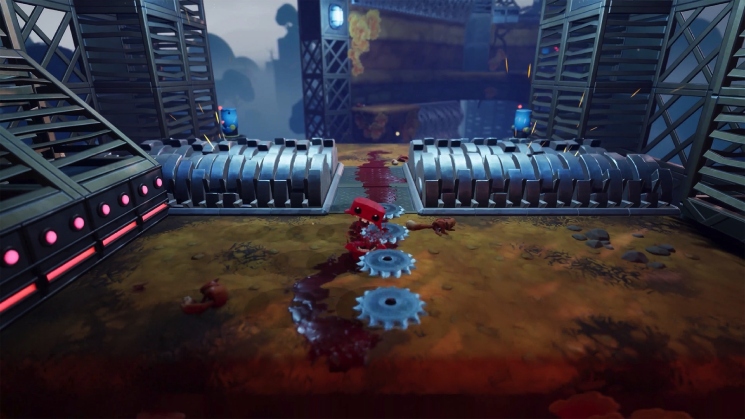
Developers have been trying to crack the problem of 3D run-and-jumping since well before Super Mario 64 messily codified the idea on the Nintendo 64 back in 1996. And there have been some good efforts to overcome the genre’s limitations, usually by trying to give players ways to cheat the inevitable plummets to their deaths caused by issues of control and perspective. But not even Nintendo has managed to consistently deliver 3D games that fulfil the basic demand of any game in the platforming genre: Knowing, when you begin a jump, exactly where you’re going to land at the end of it.
This is a solved problem in the two-dimensional space: You don’t have to be a world record runner to know how fundamentally, gloriously predictable the original Super Mario Bros. can be. When you send Mario leaping into the air at max velocity, he’s always going to come back down on the exact same block/turtle/sentient hostile mushroom man; you can execute a bit of wiggle on it, but the simplicity of the game’s inputs means there’s little room for human error to creep in to Mario’s jumps. It’s part of what made the original Super Meat Boy so compelling with its update of the old-school formula: You could be going insanely fast, but both you, and the level designers, knew where you were going to come down at the end of a leap. It might take you a while to land a workable line, but once you did, it was just a matter of trusting the game’s simplified physics.
3D spaces don’t work that way. Even if you somehow achieve perfect control of what has suddenly gone from four axes of movement to 360—never a guarantee, in my experience—the introduction of perspective into the problem massively complicates everything. (Not even “Push right” can be entirely trustworthy when the player suddenly has control over where “right” is.) Sure, you can lock the camera into a fixed perspective, the way Super Meat Boy 3D does, but even then you’re wrestling, on a near constant basis, with problems of depth. The majority of my hundreds of deaths in Super Meat Boy 3D haven’t come because of a cunning sawblade or flying missile, but because I didn’t really know where Meat Boy would be arriving at the end of one of my big jumps into space: On the platform I thought I’d lined up with? In the foreground? A few inches into the background? Anything but the ideal outcome quickly means death. (The game attempts to correct for this by putting a circle under Meat Boy’s shadow, to try to help you do a bit of rangefinding, but he’s also so squirrely in the air that it can be near-impossible to make use of it.)
The wildest thing about Super Meat Boy 3D is that it’s still a pretty fun time, despite what might seem like a basic unplayability. Its early run of levels are generous enough that you don’t really have to worry about precision: You can just fly through the scenery and exult in the motion, and if you die here or there from an unfair jump, hell, the levels only take 20 seconds to play through. (I also can’t be entirely harsh on any video game that includes a nostalgia level based around Rare’s little-lamented N64 title Blast Corps, a guilty pleasure of mine.) It’s only once you get into the real guts of the game—not just its later levels, but also boss fights that can demand minutes of one-hit-kill perfection at a time—that SMB3D’s problems become first glaring, and then outright blinding. It turns out you can get pretty far on a broken idea—just maybe not far enough.