
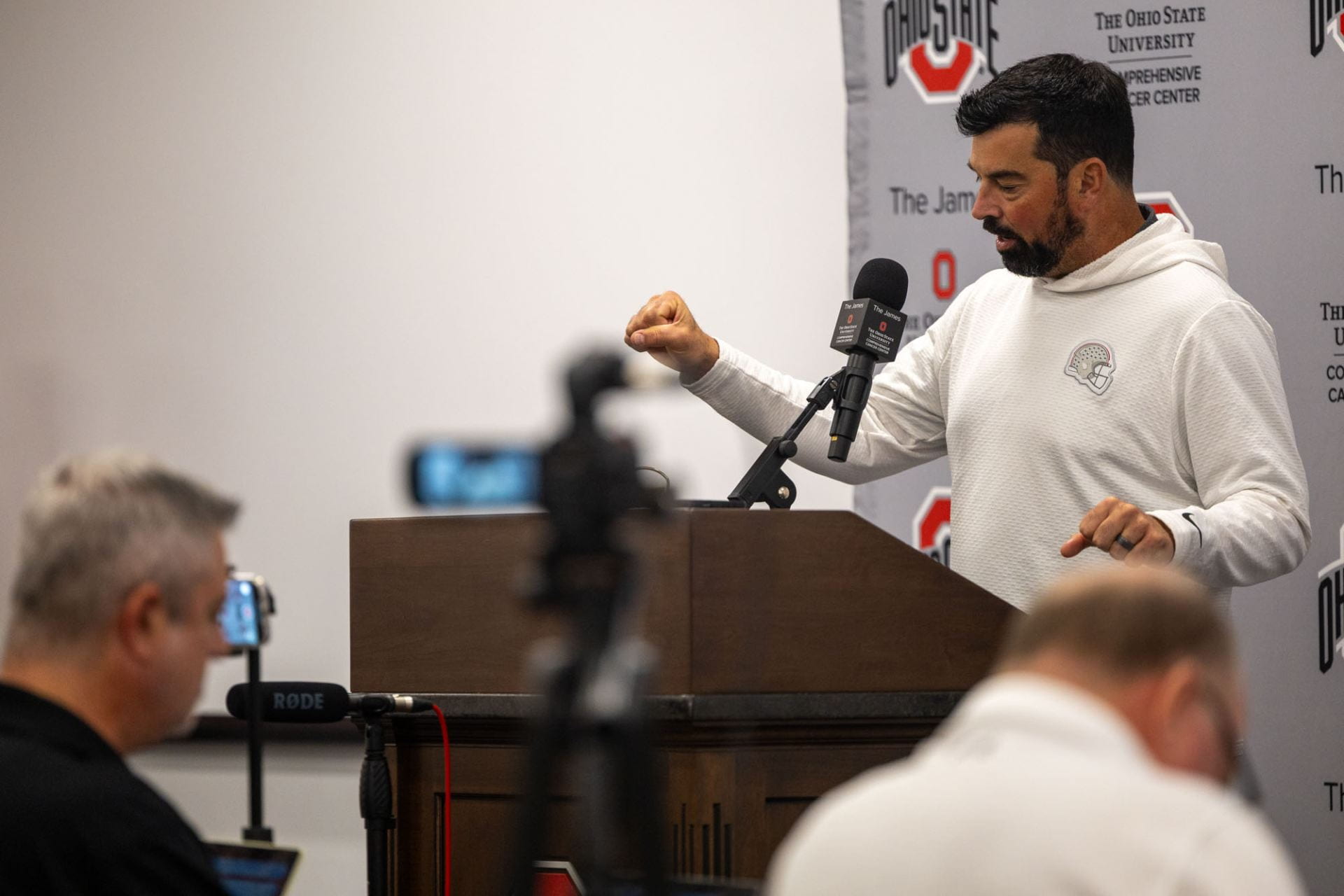
Ryan Day spoke to the media Monday at the Woody Hayes Athletic Center. Credit: Sandra Fu | Managing Photo Editor
Buckeye football will return to Ohio Stadium in just a few days.
Following the team’s final spring practices this week, Ohio State will hold its annual Scarlet and Gray Game on Saturday at noon in Ohio Stadium.
Head coach Ryan Day spoke Monday at the Woody Hayes Athletic Center ahead of the scrimmage, and here are three takeaways from Day’s press conference.
Game format will include live tackling
In college football, programs have flexibility in how physical they make their spring games. Some schools, including Texas and Missouri, have eliminated traditional spring games or shifted toward practice-style formats.
Ohio State will take a different approach.
Day said the Buckeyes plan to include live tackling for most of the game, with only limited “thud” periods.
“We’ll be tackling the whole time, maybe a drive or two of thud, but we’ll be tackling the rest of them,” Day said.
The format is especially important for Ohio State’s 51 newcomers, who will get their first experience playing in front of a crowd at Ohio Stadium.
Day said the staff will balance development with caution, limiting exposure for players with significant game experience.
“We’ll also be smart and make sure we’re not putting guys who played a whole bunch of football out there,” Day said. “You don’t want to risk any type of injury. But some of these guys do need to play, and then it gives us some feedback going into the preseason on how guys are and what we can expect when they go into games.”
Injuries could lead to pass-heavy approach
Ohio State is expected to be thin at running back Saturday.
Last season’s leading rusher, Bo Jackson, and sophomore Isaiah West have missed spring practice while recovering from shoulder surgeries. Anthony “Turbo” Rogers and freshman Legend Bay are also expected to be unavailable.
“[Rogers] is probably not going to make it, [Bay] is probably not going to make it, so we’re down running backs,” Day said.
Because of those absences, Ohio State may rely more on its passing game.
“Not that we won’t run the ball, but with those guys down, you probably won’t get as much of that,” Day said.
The shift could provide valuable reps for quarterbacks, receivers and both sides of the passing game.
“We’ll have to throw the ball some, which is good for the quarterbacks to get the ball out of their hand and see how they handle the environment,” Day said. “You’ll get a chance to see the ball with the wide receivers and see what those guys do, and then pass rush and pass protection.”
One transfer portal window changes roster approach
This offseason marks the first under the NCAA’s new transfer portal structure, which eliminates the spring window and leaves a single period in January.
Day said the change creates more roster certainty throughout the spring.
“Once you have your team, you pretty much have your team,” Day said. “That’s in January, and you have that all the way through the next year.”
While injuries can still occur, teams no longer have the option to address them through a spring portal.
“There are injuries, there are certain things that could happen, but you can’t replace them,” Day said.
Despite that limitation, Day said the structure has allowed Ohio State to focus more on development during spring practice.
“The pluses are, we know what we have and we have a full roster, so spring can be a little more productive that way,” Day said. “Now we’re not going to be sitting around dealing with another round of conversations and negotiations.”