
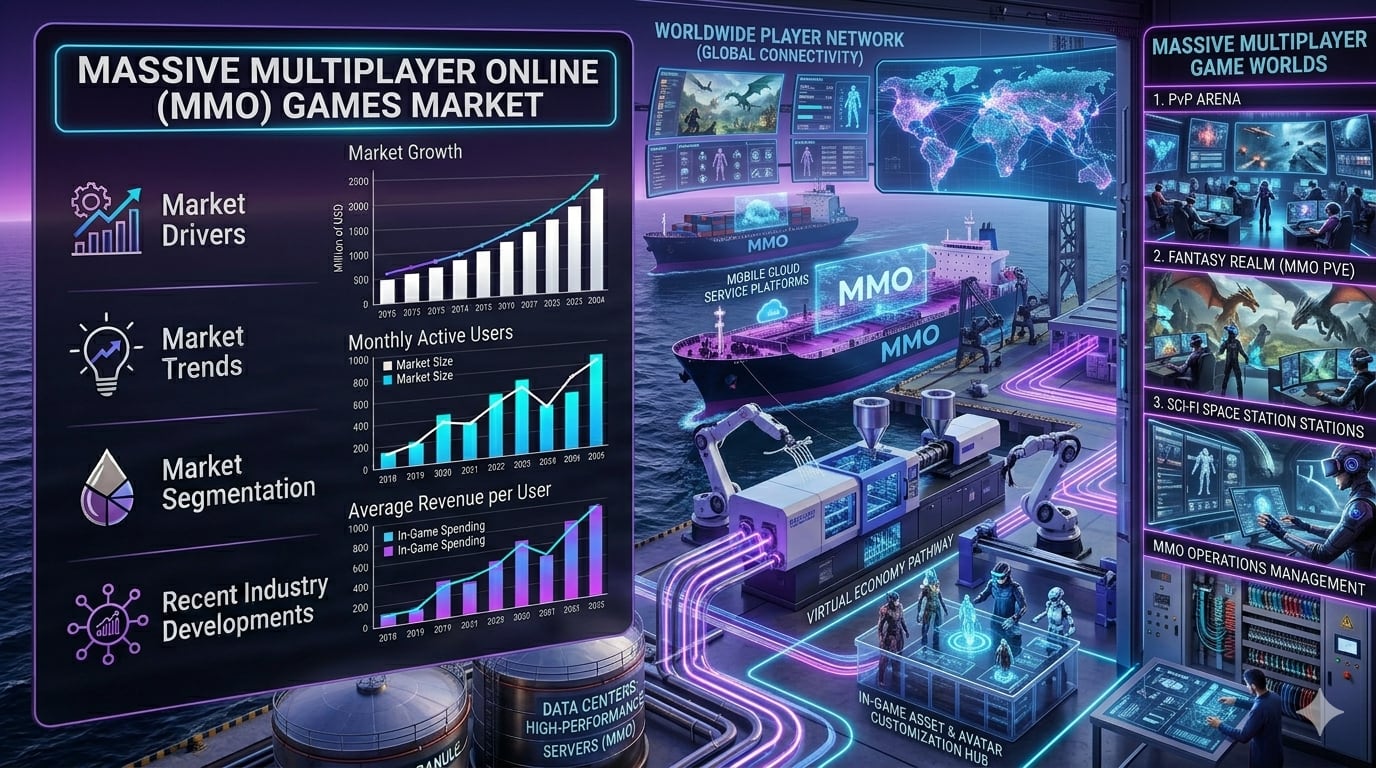
According to IMARC Group’s latest research publication, The global massive multiplayer online (MMO) games market size reached USD 61.3 Billion in 2024. Looking forward, IMARC Group expects the market to reach USD 135.1 Billion by 2033, exhibiting a growth rate (CAGR) of 9.19% during 2025-2033.
How AI is Reshaping the Future of Massive Multiplayer Online (MMO) Games Market
Adaptive Boss Behavior and Real-Time Enemy Intelligence: AI-driven bosses analyze player tactics and adjust combat strategies dynamically. WEMADE partnered with NVIDIA to develop Asterion, the world’s first AI boss for MIR5, showcased at CES 2025, creating unpredictable encounters that adapt to individual player skill levels and team compositions in real-time battles.
Intelligent NPC Interactions and Dynamic Storytelling: Machine learning enables non-player characters to remember past interactions, develop unique personalities, and respond contextually to player choices. AI-powered NPCs generate personalized dialogue, evolve relationships based on player behavior, and create emergent storylines that differ for each player rather than following scripted patterns.
Procedural Content Generation and World Building: AI algorithms create diverse environments, quests, and challenges while players explore. Systems analyze player preferences to generate tailored dungeons, missions, and terrain features, ensuring fresh content without years of manual development. HoYoverse’s upcoming Genesis project leverages Unreal Engine 5 with heavy AI integration for dynamic world creation.
Explore Updated 2026 Market Trends & Analysis
Massive Multiplayer Online (MMO) Games Industry Overview
The global esports market provides momentum for MMO game adoption, projected to reach USD 10.1 Billion by 2033. Mobile gaming dominates with 90 percent of India’s gaming revenue from 600 million tech-savvy youth under 35 years old. The Esports World Cup features USD 60 million prize pools while Internet users worldwide will increase 47 percent from 5.35 billion to 7.9 billion by 2029, expanding the addressable player base for persistent online worlds.
Massive Multiplayer Online (MMO) Games Market Trends & Drivers
The explosive growth of mobile gaming infrastructure is reshaping MMO accessibility and player demographics worldwide. Smartphone penetration combined with affordable data plans enables millions of first-time gamers across India, Brazil, and Indonesia to access persistent online worlds previously limited to PC enthusiasts. 5G rollouts deliver latency below 30 milliseconds, supporting large-scale real-time combat on handheld devices without perceptible lag. Mobile MMO titles capitalize on ubiquitous connectivity, with games optimized for mid-tier phones featuring GPU capabilities that enable console-grade visuals. Regional payment systems like PIX in Brazil and UPI in India reduce friction for microtransactions, while telecom subsidies lower data costs and drive daily logins among mobile-first teens. Asia-Pacific accounts for 42 percent of AI drying machine sales with similar patterns emerging in mobile gaming, where shortened handset replacement cycles encourage cross-play between mobile and PC cohorts, expanding total addressable players beyond traditional desktop segments.
Free-to-play business models combined with sophisticated monetization strategies are driving sustainable revenue growth across MMO ecosystems. Publishers increasingly depend on in-game cosmetic sales, season passes, and live-ops events to convert large free player bases into predictable cash flows without requiring upfront purchase commitments. AI-powered pricing optimization systems, similar to those used by Panda Retail achieving significant transaction value improvements, enable dynamic bundle pricing and personalized offers based on player spending patterns. The cloud kitchen segment growing at 4.15 percent mirrors the live-service model expansion, where developers focus on content updates, community engagement, and retention optimization rather than one-time sales. Hybrid monetization combining subscription tiers with item shops provides flexibility for different player segments, from casual free users to dedicated whales investing thousands annually. NetEase announced generative AI integration for Justice Online, while companies implement machine learning to suggest complementary items during purchase flows, increasing average revenue per user through intelligent upselling without aggressive tactics that damage player satisfaction.
Esports legitimization and competitive gaming infrastructure are elevating MMO titles from casual entertainment to professional career paths. The International Olympic Committee confirmed plans for inaugural Olympic Esports Games in 2027, bringing government backing, institutional funding, and legacy sponsors into ecosystems previously operating on grassroots models. Mobile Legends: Bang Bang reached 4,132,224 peak viewers, crushing traditional PC tournament numbers and demonstrating mobile esports’ massive appeal. PUBG Mobile World Cup features USD 3 million prize pools matching established Counter-Strike events, attracting top talent to mobile competitive scenes. Community casting accounted for 45.8 percent of League of Legends Worlds 2024 watch time, up from 2.4 percent in 2022, as streamers leverage their influence to connect with wider audiences. Traditional esports organizations now field full rosters across multiple MMO titles, recognizing that professional competition drives player engagement, extends title lifecycles, and creates marketing opportunities through tournament sponsorships, team merchandise, and broadcast rights that generate revenue streams beyond direct game sales.
Leading Companies Operating in the Global Massive Multiplayer Online (MMO) Games Industry:
Activision Blizzard Inc. Ankama CCP ehf. (Pearl Abyss) ChangYou.com Limited (Sohu Inc.) CipSoft GmbH Cryptic Studios Inc. (Embracer Group) Electronic Arts Inc. gamigo AG (Media and Games Invest) GungHo Online Entertainment Inc. Jagex Ltd. (The Carlyle Group) Krafton Inc. NCSOFT Corporation NetEase Inc.
Massive Multiplayer Online (MMO) Games Market Report Segmentation:
By Genre:
MMORPG MMOFPS MMORTS Others
MMORPG represents the largest segment, as it offers immersive role-playing experiences with character progression, social guilds, and persistent virtual worlds that encourage long-term player engagement.
By Type:
Free to play (F2P) Pay to play (P2P)
Free to play dominates the market due to zero entry barriers, widespread accessibility, and proven monetization through cosmetic items, battle passes, and optional premium features.
Regional Insights:
North America (United States, Canada) Asia Pacific (China, Japan, India, South Korea, Australia, Indonesia, Others) Europe (Germany, France, United Kingdom, Italy, Spain, Russia, Others) Latin America (Brazil, Mexico, Others) Middle East and Africa
Asia Pacific leads the MMO games market driven by massive smartphone adoption, established gaming cultures in China and South Korea, and rapidly growing player bases across Southeast Asian markets.
Recent News and Developments in Massive Multiplayer Online (MMO) Games Market
January 2025: WEMADE unveiled Asterion, the world’s first AI-driven boss character, at CES 2025 for upcoming MMORPG MIR5. The pioneering developer became the first MMORPG studio globally to collaborate with NVIDIA on AI boss development, creating adaptive enemies that analyze player tactics and adjust combat strategies in real-time, pushing boundaries of interactive gameplay experiences. 2024: NetEase announced integration of generative AI into Justice Online, their upcoming MMO title. The implementation features AI-powered NPCs with dynamic dialogue systems, procedurally generated quest content, and adaptive storytelling elements that respond to individual player choices, marking significant advancement in personalized gaming experiences within massively multiplayer environments. Late 2024: Riot Games reversed long-standing policies by allowing League of Legends and Valorant esports teams to partner with betting companies. The policy change opens new revenue streams for professional organizations, bringing these flagship titles in line with established esports betting markets in Counter-Strike and Dota 2 ecosystems. 2024: HoYoverse, creators of Genshin Impact and Honkai: Star Rail, began development on Genesis, a fantasy-themed MMO built on Unreal Engine 5. The ambitious project features heavy artificial intelligence integration, PvP elements, all-terrain battle AI, intellectual NPCs, and AI-stimulated ecosystems, representing major technological shift from the studio’s previous Unity-based titles. 2024: Krafton reported record revenue of KRW 1.54 trillion (approximately USD 1.18 billion) with operating profit of KRW 703 billion in first half, marking double-digit year-over-year growth. The seven-year-old PUBG: Battlegrounds continues bankrolling the company while the publisher acquired Eleventh Hour Games, developers of action RPG Last Epoch with over three million PC copies sold.
Note: If you require specific details, data, or insights that are not currently included in the scope of this report, we are happy to accommodate your request. As part of our customization service, we will gather and provide the additional information you need, tailored to your specific requirements. Please let us know your exact needs, and we will ensure the report is updated accordingly to meet your expectations.