
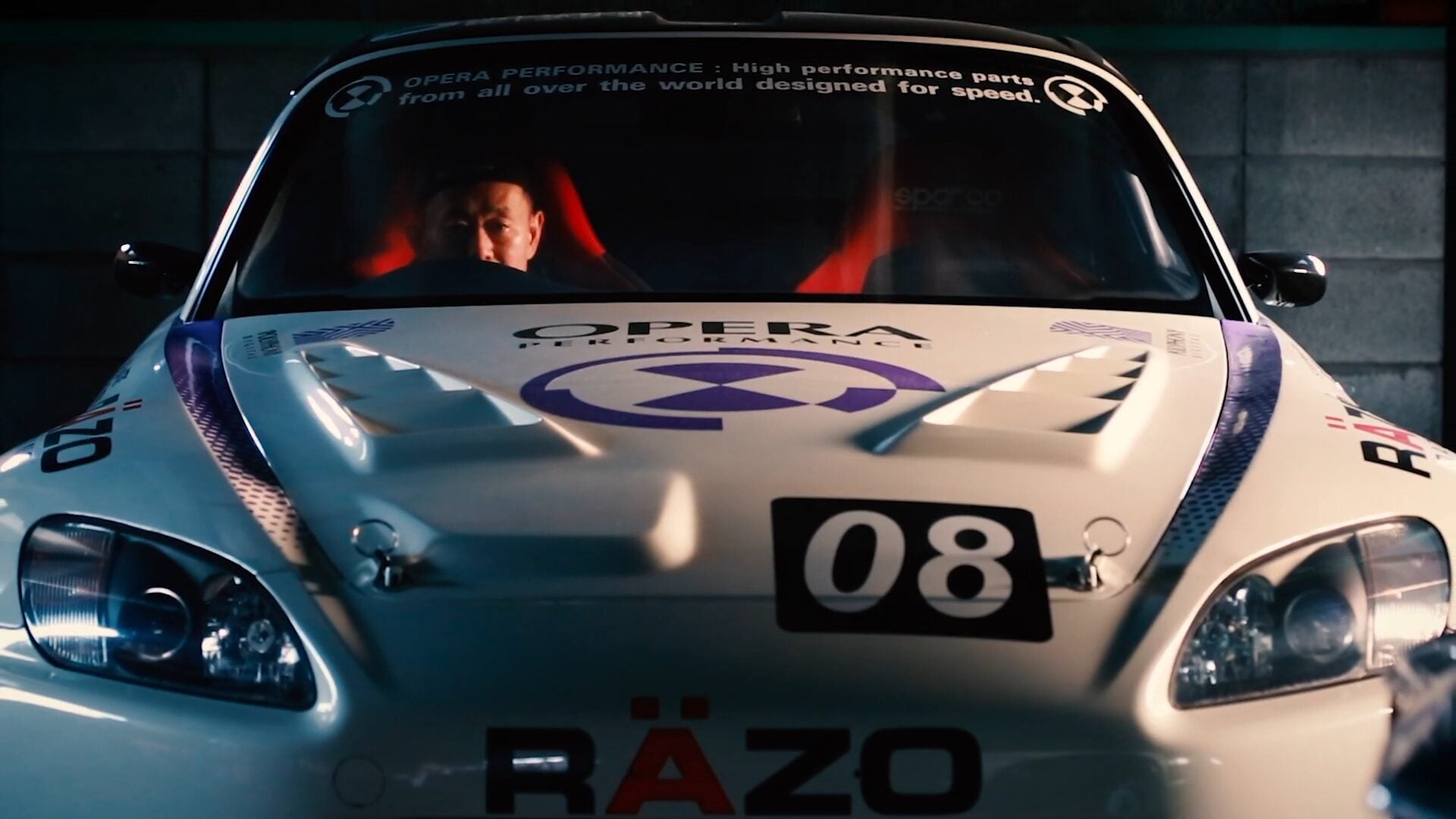
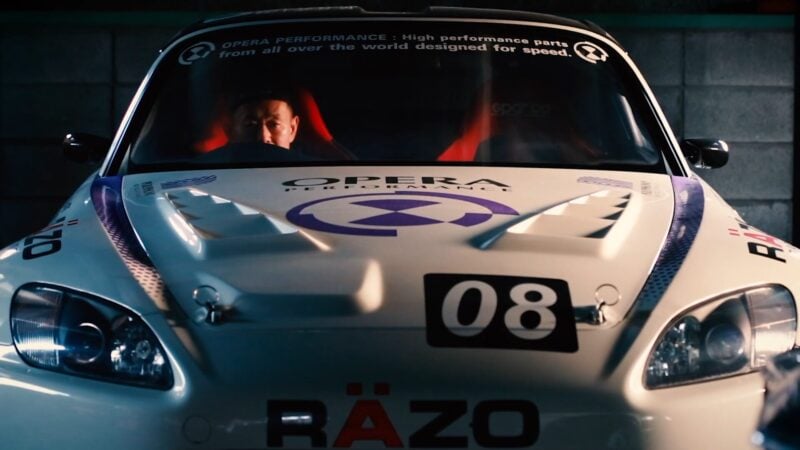
If you spent any time in older Gran Turismo games, you may have noticed a small, relatively obscure name among the roster of Japanese tuning houses called Opera Performance. What you probably didn’t realize is that Opera Performance and Polyphony Digital share a connection that goes far deeper than a simple licensing deal.
Unlike the larger operations of HKS, Amuse, or MINE’S, Opera Performance has always been a one-man shop, run entirely by a fabricator named Yasukichi Yamamoto out of Fukuoka, Japan. Yamamoto has recently been sharing the history of his company through a series of Instagram posts, and the story he’s telling is a fascinating one.
It paints a picture of a relationship between a car builder and a game creator that is, in many ways, without parallel in either industry.
Table of Contents
A Shared Identity
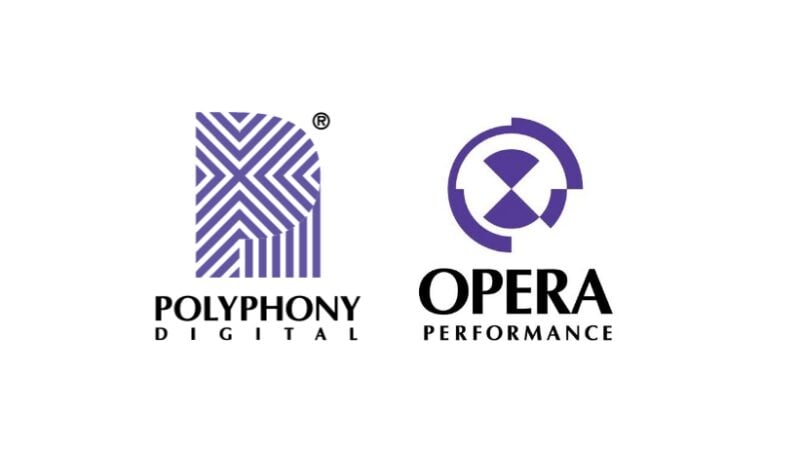
The first thing that jumps out when you look at Opera Performance and Polyphony Digital side by side is the branding. Both companies use the same typeface for their logotypes, and share a similar color sensibility. That’s not a coincidence.
As Yamamoto revealed in one of his posts, the Opera Performance name, logo, and complete livery design were all created by Kazunori Yamauchi and the Polyphony Digital design team. When a commenter on Instagram pointed out the visual similarity between the two logos, Yamamoto confirmed it was intentional, part of expressing what he called “a unified philosophy and identity”.
Even the names carry a musical thread. “Opera” and “Polyphony” are both rooted in musical tradition, with polyphony referring to the simultaneous combination of multiple melodic lines, and opera being the grand theatrical form that brings music, narrative, and performance together. It’s a subtle but telling parallel, and one that speaks to the artistic approach Yamamoto and Yamauchi bring to their respective crafts.
Kazunori Yamauchi’s S2000
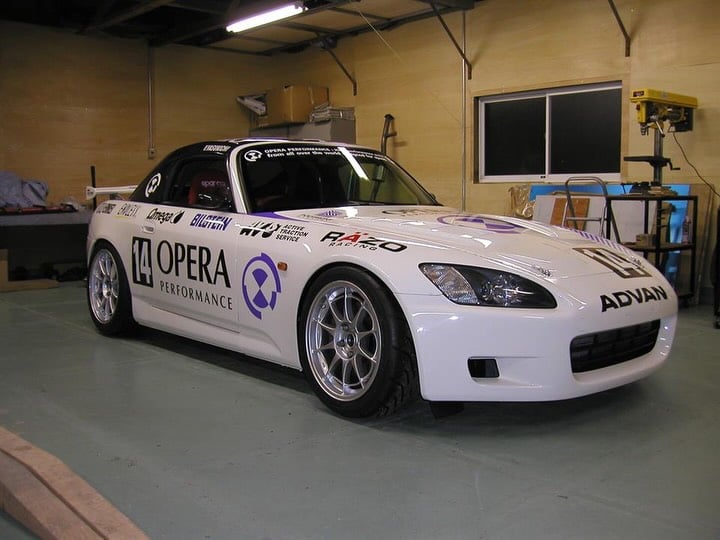
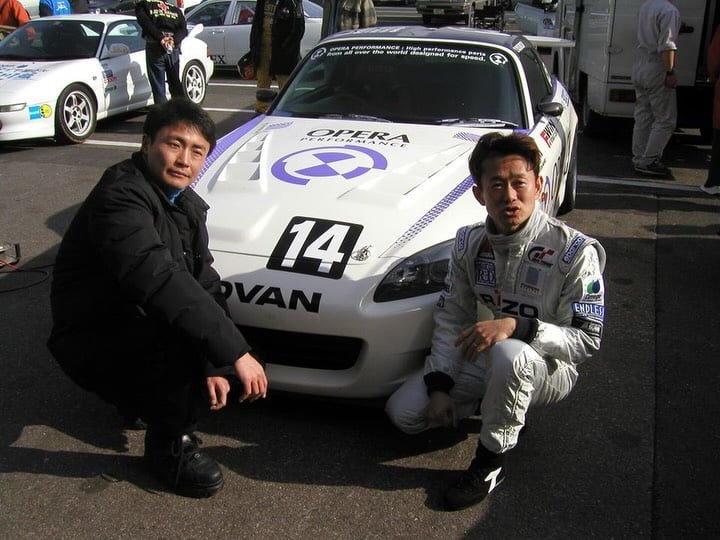
The origin of Opera Performance as we know it traces back to 2002, when Yamamoto built the Opera S2000 based on a yellow, Japanese-spec, right-hand-drive Honda S2000 that belonged to Kazunori Yamauchi himself.
The car was completed just in time for the Tsukuba Super Battle that year, and photos of Yamamoto and the finished car were taken at the circuit on the day of the event.
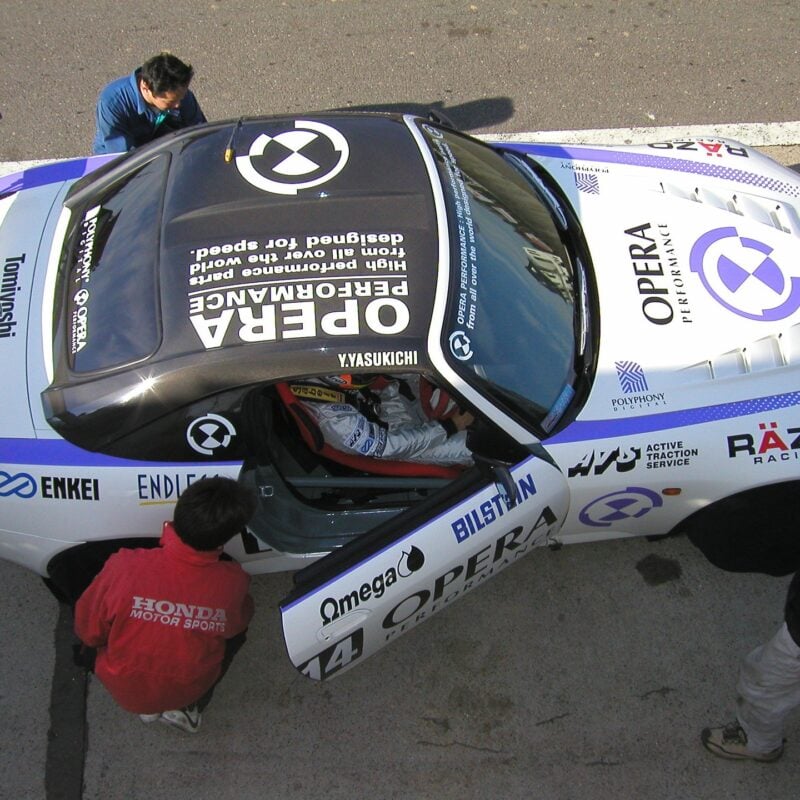
The build philosophy was distinctly Yamamoto’s: balance over brute force.
The car weighed around 980kg, ran on ADVAN A048 tires, and used a naturally aspirated 2.0-liter engine, even though the regulations would have permitted a displacement increase to 2.2 or even 2.4 liters.
Yamamoto chose to stay at 2.0 liters, not because it was strategically optimal, but because he didn’t have access to engine builders with larger displacement experience, nor the budget to commission a fully built motor.
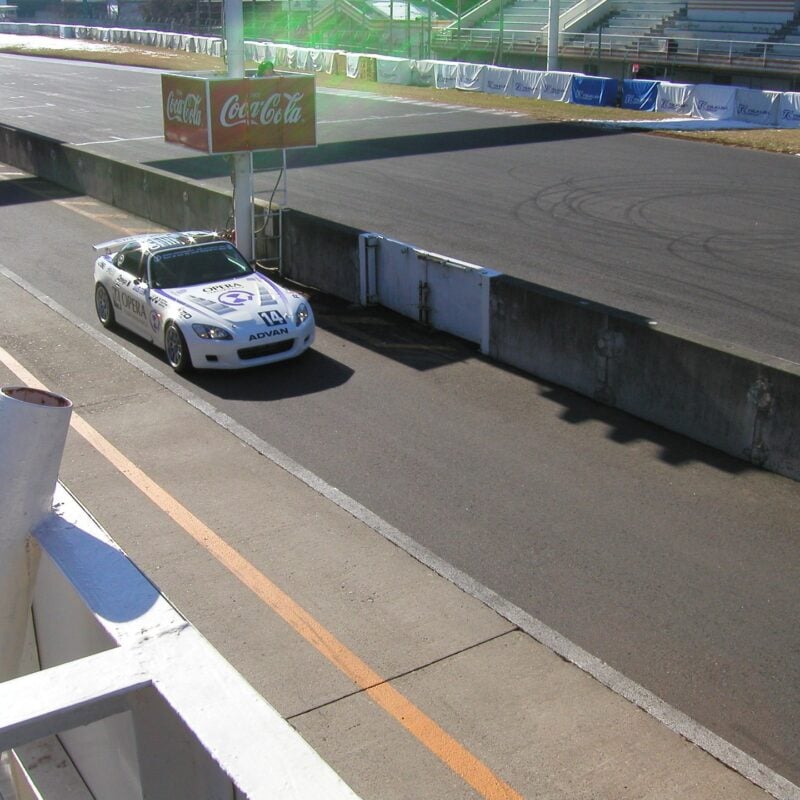
In 2002, the car posted a 1:02.22 at Tsukuba under what Yamamoto describes as near-shakedown conditions. After revising the rear suspension geometry over the winter, the time came down to 1:01.4 in 2003. The car was not the fastest in its class that year, with other competitors running larger displacement engines and wider tires to post sub-one-minute laps.
Yamamoto has always been honest about where those results sit, and more importantly, about what they revealed. The Tsukuba experience sharpened his understanding of the relationship between chassis balance and outright power, and that clarity would inform everything he built from that point forward.
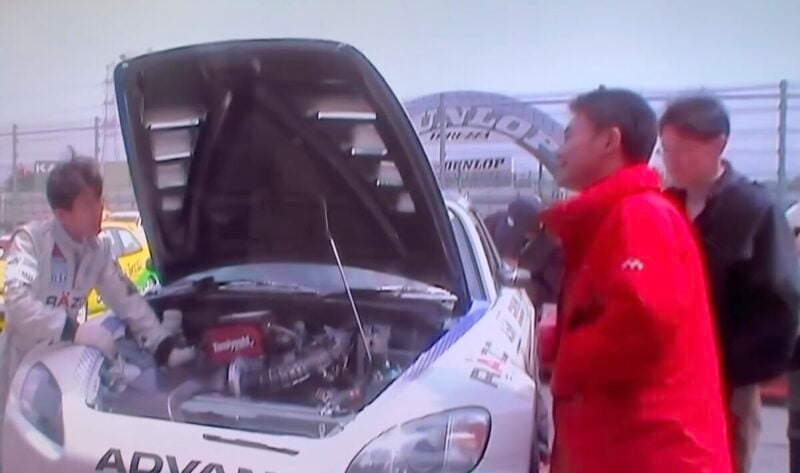
Simulation Before Reality
One of the most remarkable details to emerge from Yamamoto’s account is how deeply Gran Turismo’s development tools were integrated into the Opera S2000 project.
Before the time attack at Tsukuba, the car was brought into what Yamamoto described as a “development module” used for Gran Turismo. The simulation data was built from the real car’s specifications, including corner weights, engine output, tire dimensions, and gear ratios.
Yamamoto had been considering a final drive ratio change, but testing it in reality required both time and money. Yamauchi suggested they test it virtually instead. The result was clear: the stock ratio was faster.
The gap between simulation and reality stuck with Yamamoto. In the sim, with Yamauchi driving, the car was about half a second quicker.
In the real car, with Yamamoto behind the wheel, the margins were thinner, and every small mistake cost time. That half-second gap became a source of motivation, a tangible measure of what could still be extracted from the car and from himself as a driver.
The team responded with an obsessive focus on weight reduction.
In 2002, they cut down the stock fuel tank. In 2003, Yamamoto fabricated a custom aluminum tank with just ten liters of capacity, enough for roughly ten laps at Tsukuba, which allowed them to run a single fuel pump and save additional weight. Rear brake discs were drilled to shave grams. Every component was reconsidered. Each decision brought a deeper understanding of the machine.
Yamamoto’s mind was already racing ahead of the car itself. He was thinking about a pipe-frame chassis, further weight reduction, a larger displacement engine. But that path would have transformed the S2000 into something unrecognizable. Then, Yamauchi said “let’s stop time attack”.
Looking back, Yamamoto understands and appreciates that decision. The Opera S2000 was always meant to balance performance and elegance, and preserving that identity mattered more than chasing lap times. It’s a philosophy that has guided his work ever since.
The 350ZRS
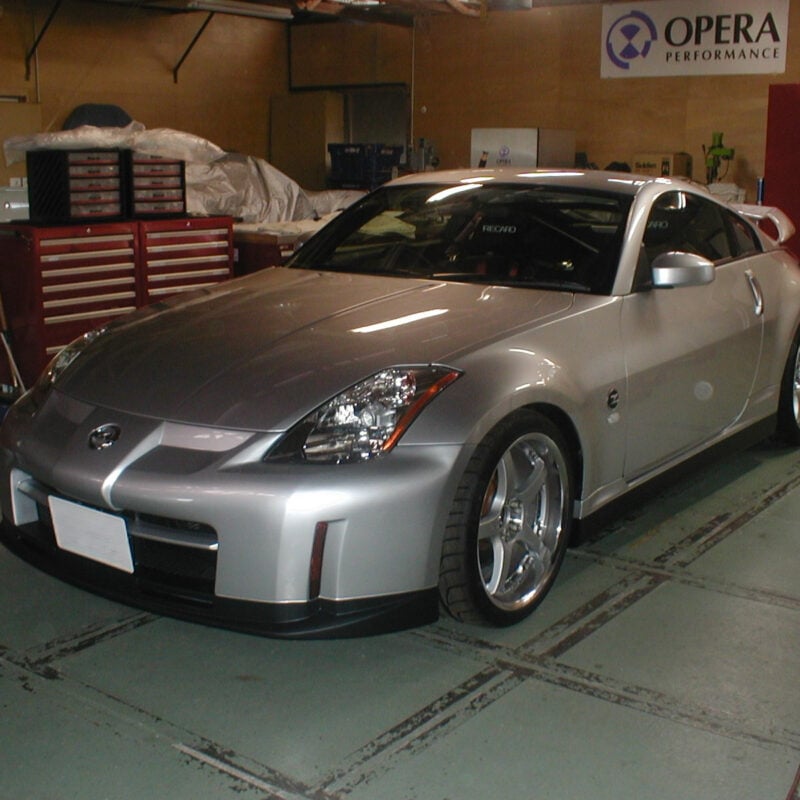
The S2000 wasn’t the end of the collaboration. Just four months after the 2003 Tsukuba Super Battle, Yamauchi approached Yamamoto with another project, this time built around his personal Nissan Z33.
The car arrived at Yamamoto’s workshop directly from a Nissan dealership with less than 50 kilometers on the odometer and was already fitted with an aero kit designed by Polyphony Digital. It was, as Yamamoto describes it, a blank canvas from the very beginning.
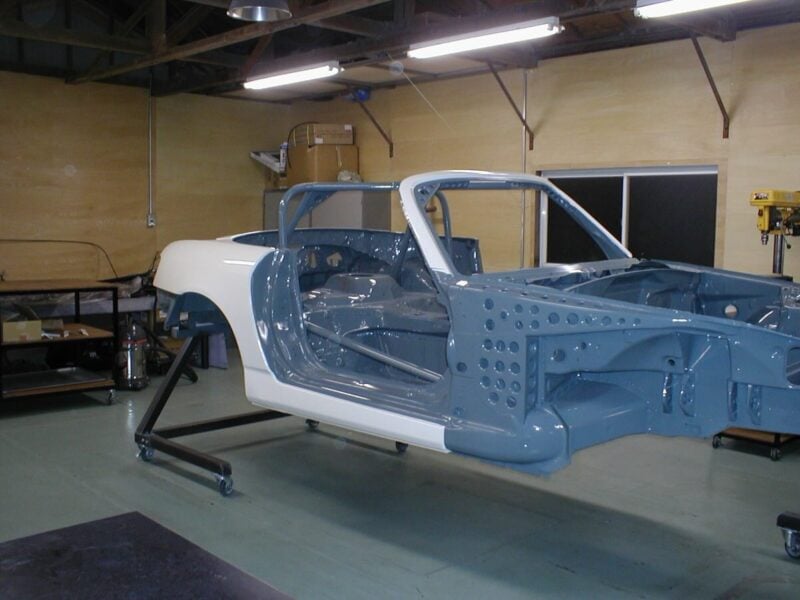
What began as a chassis reinforcement project gradually grew into something much more ambitious. Yamamoto spent over 500 hours on the body and the roll cage alone, but this was never about simply bolting in additional structure.
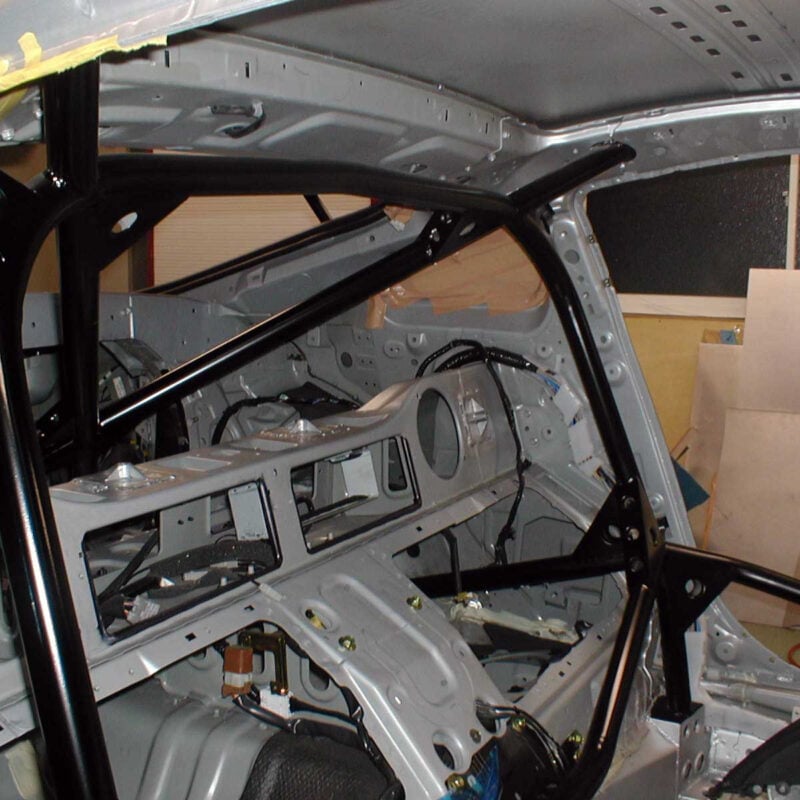
The cage was designed to connect key points of the chassis together into a single, continuous system: from the main hoop to the rear subframe, through the center tunnel, and into reinforced mounting points at the floor and crossmembers.
Every connection had a purpose. Everything was tied together to create a more rigid, precise, and responsive platform. “This was never just a roll cage,” Yamamoto recalls.
The finished car became known as the “350ZRS,” a name created by Yamauchi himself along with the aero package that defined its look.
Like the Opera S2000 before it, the 350ZRS would go on to be introduced in Gran Turismo 4, giving players yet another piece of the real-world Opera Performance catalog to experience virtually.
Revisiting the build photos recently, Yamamoto expressed gratitude for the opportunity, noting that a project of this scale represented a significant investment on the owner’s part. It’s a sentiment he says he feels about many of the cars he’s built over the years, past and future. Trust, as always, is the foundation.
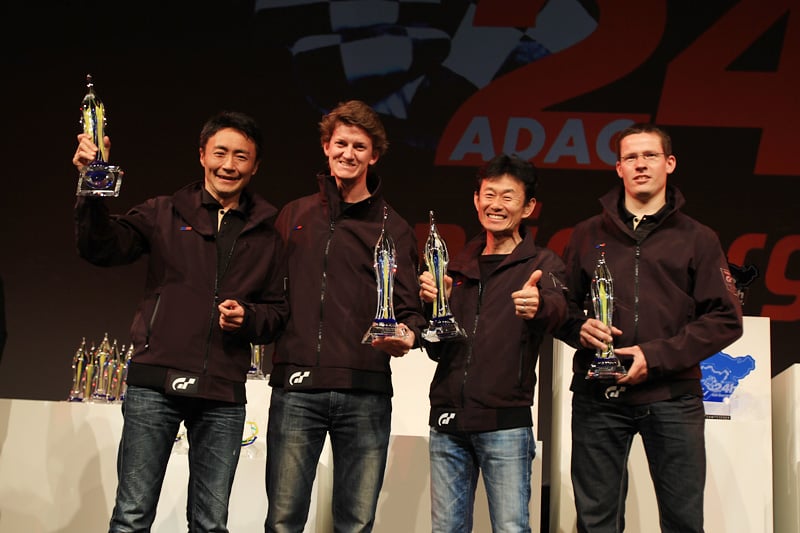 Kazunori Yamauchi, Lucas Ordonez, Yasukichi Yamamoto, and Tobias Schulze
Teammates at the Nürburgring
The relationship between Yamamoto and Yamauchi isn’t just one of builder and client. It extends to the racetrack. In 2011 and 2012, the two competed together at the Nürburgring 24 Hours, sharing driving duties in a Nissan GT-R fielded by Schulze Motorsport. They won their class both years.
In 2011, the team of Yamauchi, Yamamoto, Tobias Schulze, and Michael Schulze took first in the SP8T class despite significant time lost to mechanical issues in the pits, finishing 36th overall with 134 laps completed. Yamauchi himself brought the car across the finish line.
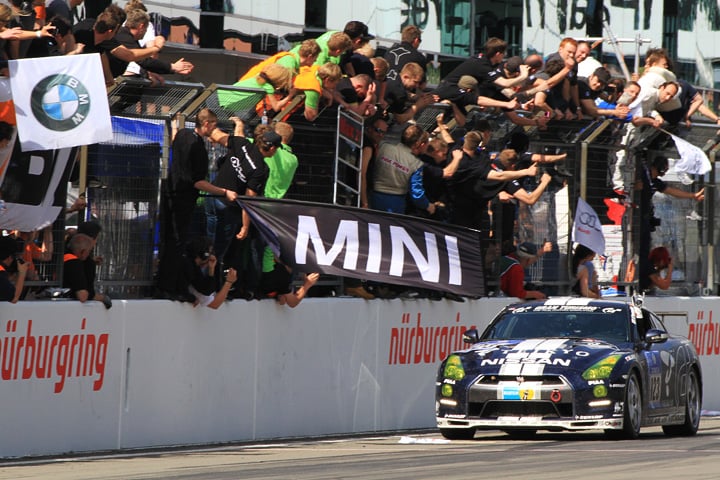
The following year, Yamamoto and Yamauchi returned alongside Tobias Schulze and GT Academy graduate Lucas Ordoñez, claiming their second consecutive class victory.
The shakedown for the 2012 race car took place at Sugo Circuit, where both Yamauchi and Yamamoto worked through three full days of testing to understand the car’s characteristics and sort out teething issues before the GT-R was shipped to Germany.
An Automotive Takumi
There’s a Japanese concept, takumi, that refers to a master craftsman, someone who has devoted their life to refining a singular skill until it approaches art. Watching Yamamoto describe his work, it’s hard not to see him in that light.
His grandfather started a garage. His father was a sheet metal craftsman. As a boy, Yamamoto watched his father race and saw a go-kart race that shook him so deeply he knew he wanted to dedicate his life to motorsport.
After work, he would tinker with his own car, then started working on friends’ cars, until eventually it became his livelihood.
In a short film published on the Opera Performance YouTube channel in celebration of the company’s 20th anniversary, Yamamoto speaks about his philosophy in terms that sound almost spiritual. The film is a beautiful piece of work, created by Nav Amaras as a passion project and tribute to both Yamamoto’s craftsmanship and the Gran Turismo series. It features a particularly striking instrumental cover of Gran Turismo’s iconic “Moon Over the Castle” performed by Teo Wei Yong.
In the film, Yamamoto compares the car’s body and chassis to the human core, the structure that connects the limbs, without which high performance is impossible.
He describes beauty as something that appears when parts are strong and light. He talks about understanding what makes a car fun, and how control extends beyond your arms and legs.
His approach to customer work is what he calls “100% Omakase,” the Japanese dining tradition in which you entrust the chef entirely with your meal. It requires deep trust between customer and craftsman, and in return, Yamamoto uses his full skill to create something uniquely tailored to each client. Opera Performance remains a one-man operation to this day.
“Automated manufacturing has great precision and scale,” Yamamoto says, “but the final magic is in the hands of a craftsman. With this touch, the soul that dwells within arises. Maybe even humanity within the machine.”
Two Sides of the Same Philosophy
When you step back and look at the full picture, the parallels between Yamamoto and Yamauchi are striking. Both are perfectionists who have spent decades refining their craft. Both approach cars with a blend of technical rigor and artistic sensitivity.
In many ways, Yamamoto is the real-world tuning counterpart to Yamauchi, just as Opera Performance is a physical-world analogue to Polyphony Digital.
Where Yamauchi builds virtual cars with obsessive fidelity, Yamamoto builds real ones with the same exacting standards. Where Polyphony Digital pursues the perfect simulation, Opera Performance pursues the perfect chassis. The shared branding, the shared philosophy, and the shared racing campaigns are expressions of a genuine and enduring partnership between two people who see cars and the act of building them in fundamentally the same way.
Yamamoto also serves as the caretaker of Yamauchi’s personal car collection, a detail that speaks volumes about the trust between the two men. It’s the kind of arrangement that only exists between people who share not just a professional relationship, but a deep mutual respect for each other’s craft.
For Gran Turismo fans, the Opera S2000 was always one of the franchise’s more interesting curiosities since it first appeared in GT4’s car list. Now, thanks to Yamamoto’s willingness to share his story, we can finally appreciate just how much history and intention was packed into that unassuming car and the remarkable friendship that brought it to life.
You can follow Yamamoto’s ongoing history of Opera Performance on Instagram (@operaperformance), and watch more videos from him on the Opera Performance YouTube channel.
See more articles on Kazunori Yamauchi and Polyphony Digital.