

It is, perhaps, the perfect time in Cuba to make a horror game.
Intertwined oil shortages and an economic crisis sparked by fuel shortages and the continued U.S. embargo, have rocked the island nation, leading to daily rolling blackouts as well as food, water, and medical shortages.
Back in 2016, when Cuban indie developer Josuhe Pagliery, started work on his first game, it garnered international attention at a time when he thought things couldn’t get any more difficult.
“I always believed Saviorless would be the game of difficulties,” Pagliery told me recently via email. “If you remember, there was no internet on the island in 2016 when development began. And it turns out that now we’re living through daily blackouts of 20 hours! One dollar equals 510 Cuban pesos compared to 24 in 2016; without exaggeration, more than 85 percent of the people who collaborated on the first project are now outside of Cuba; and to top it off, there’s now also the risk of an invasion or the implementation of a total naval blockade.”
Now, deep in development on his second game, Pagliery says the increasing difficulty of not just making a game in Cuba, but surviving, has helped to shape what this new title will be.
“After two quite stressful months with these thoughts in the middle of blackouts, I realized that making this game, with this subject matter, in this particular moment and context possessed a unique value as a work,” he wrote. “The potential to become an artistic record of what appears to be the end of an era in Cuba. I convinced myself that my terrible context could also be used as an artistic opportunity.”
His new game, Tasteless, is a low-poly 3D first-person horror game with a heavy narrative focus.
Pagliery hopes it will be the second title in a trilogy of “less” games that revolve around the concept of emptiness, and which shares some references in common with his first game.

Saviorless, considered by many to be one of Cuba’s first modern indie games, endured a tumultuous development that kicked off in 2016.
It survived a split-up of the development team, supply shortages, social unrest, and COVID, but still managed—after eight years of development—to launch as Empty Head Games’ first title.
“The reception from players was very positive, same with the press; the visual department was universally praised, as was the music,” Pagliery told me. “During development we never thought about sales, only about getting the first Cuban video game onto all major consoles and platforms. Sales were above average within what’s expected for a 2D cinematic platforming experience.”
Since release, the game sparked another wave of attention that included reviews, interviews, and presence at global events. It even received a nomination at the Indicade and Quirino awards.
Along the way, the game managed to connect with publisher Dear Villagers, and is going through the process of brought to platforms beyond the computer.
Pagliery said he hopes that the game hitting the console will lead to the studio seeing significant returns. But more important, at least for the developer, launching the game brought with it a number of important lessons and a desire to make a second independent game.
“I love making independent video games; frankly I can’t think of an activity I enjoy more,” he wrote. “No matter how much I complain about the sacrifice involved in doing it from Cuba, it’s simply the best!”

Where Saviorless was a side-scrolling 2D platform, Tasteless makes the leap to 3D and focuses much more on the game’s story.
“The game takes place mostly inside a house in Havana based on the house where I was born and raised,”Pagliery wrote, “and it’s about a father who is trying to resurrect his recently deceased son.”
The concept for the game was driven in large party by Pagliery, himself, becoming a father and realizing how completely fatherhood changes everything about a person.
The game views fatherhood not only as a “genetic and emotional bond, but also as a dynamic based on control and deformation,” he wrote. “The parallel with Cuba, starting from this family tragedy that in essence speaks of the death of the future, became increasingly present as I progressed; so I believe the project will have a certain documentary quality regarding these convulsive times in Cuban history, without necessarily being a game about Cuba.”
The core team working on Tasteless is made up of Pagliery, who serves as the game’s director, artist, writer, and designer; Miguel Nicolas, who handles programming; and Angel Menendez, who creates the 3D art and animation. The music and sound is being created by German Carrasco, and David Darias, is the technical advisor.
This time around, Pagliery hopes to get the game wrapped up in just two years, something he thinks he can accomplish despite the ever escalating challenges.
“I have much more experience, and it’s real experience, since it comes from having made almost every mistake a beginner can make and having paid the price,” he wrote. “I also now know the professional areas where I’m good, and by default, the others I should try to improve or simply avoid. The jump to 3D (although there are 2D segments within the game) represents a technical and artistic challenge, but far from seeing it as something negative, I prefer to understand it as a way to expand my expressive possibilities.”

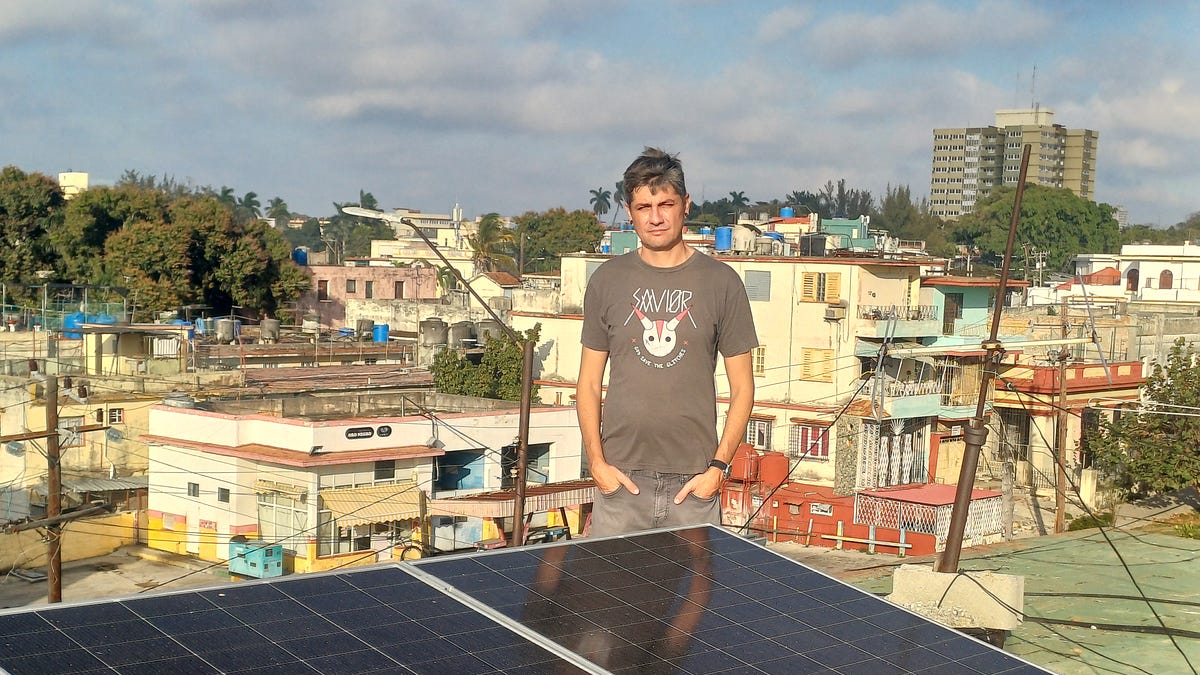
Another boon for the game’s development was Pagliery’s decision to invest much of his own money into solar panels for his home and office.
“That was the only way I found to keep working and in the process preserve some peace of mind, investing in a solar panel system, which in fact I’m using right now in the middle of a nighttime blackout to write these lines,” he wrote. “The setup consists of an inverter, a battery, and six panels of 600 watts each, located on the rooftop of my building. Thanks to this we can continue working even under critical scenarios, like when the national electrical system goes down across the entire island.”
While the electricity affords him the ability to work when others on the island may not be able to, he’s not immune to other issues the blackouts create.
“The blackouts generate a survival logic in people, where life is reduced to its most basic aspects, in other words, it feels like devolving in real time,” he wrote. “And yes, it’s true that thanks to these panels right now I’m not as affected, but my parents are, and so are the members of my team, and this generates a feeling of guilt over something that’s not in your hands to solve.”
Pagliery believes the energy problems are the result of what he calls “profound governmental neglect, marked by the absence of real investment in energy infrastructure for years,” as well as the long-lasting embargo on the island.
“It’s an infinite loop, which functions as the perfect excuse to wield before the many problems or shortcomings on the part of the state,” he added.
The accumulation of problems in Cuba have also triggers a systemic crisis that Paliery sais extend to every level of life in the nation.
“Water and gas, for example, also depend on electricity,” he wrote. ”There are literally no cars on the streets; activities like cinemas, theaters, concerts have nearly disappeared. As always happens in these cases, culture is among the first victims within a free-falling economy.
“Everything is much more negative and hopeless, but paradoxically it’s perfect for a horror game. At this point, I’m starting to process all these infinite problems and shortages as fuel to keep working. In essence, I try to convert all these multiple ‘nos’ into a creative ‘yes’.”

With the embargo heightening issues on the island and talk of the U.S. somehow taking over the country, Pagliery said everyone on the island seems to have an opinion.
Pagliery points out that the U.S has always been present in the Cuban collective imagination, either as “savior or villain.”
“Possibly the place in the world where the USA is talked about most after the USA itself is Cuba,” he added. “That has been a constant throughout my life, since school; it was practically the only thing Fidel Castro talked about in his interminable diatribes.”
Since the U.S. attacked Venezuela, the blackouts in Cuba have worsened by 20 percent, Pagliery estimates.
“That tells you that the energy crisis in Cuba had already been dragging on from long before Maduro’s fall,” he wrote. “I can attest that in interior provinces of the country, like Cienfuegos, blackouts of more than 20 hours were already a present reality since at least the year 2024.”
Pagliery believes that Cuba is is obligated to make a deal with the U.S.
“I don’t think it’s even optional,” he wrote. “I know many people, generally outside of Cuba, adore that idyllic image of David versus Goliath, but the truth is, little David doesn’t stand the slightest chance against a giant. The concrete reality is that at just 90 miles away from the USA, the tiny island of Cuba cannot afford the luxury of confronting a rival like that. These are no longer the times of Vietnam. Anyone who demands that the Cuban people immolate themselves defending blackouts and misery, whether from the comfort of a smartphone or the regime itself, would in my eyes be someone pathologically malignant. It is the Cuban people who have solely suffered the consequences of this political standoff that now dates back 67 years, never their rulers or his relatives; perhaps it’s time to give us a damn break!”
He added that only the future can tell if the US stepping in would help or harm the country.
“It’s practically impossible to make the situation being lived on the island right now any worse,” he wrote.

As for the video game industry in Cuba, Pagliery doesn’t have high hopes for its growth any time soon.
“Forget about it completely!” he wrote. “If before it was unlikely to take off, given the terrible strategies of its managers and the dubious quality of their video games, right now that’s simply impossible. In fact, in the last six years, culture specifically is one of the sectors that has suffered the most palpable deterioration and institutional abandonment, both in the quality of its offerings and in its mere presence on the island.”

Inside Outbound with vanlife true-believers, researchers, and cozy game dev Square Glade

The Greenening is a relaxing yet radical exploration of how we play incremental games

A visual tour of Fortnite’s Ice King and Foundation Return