
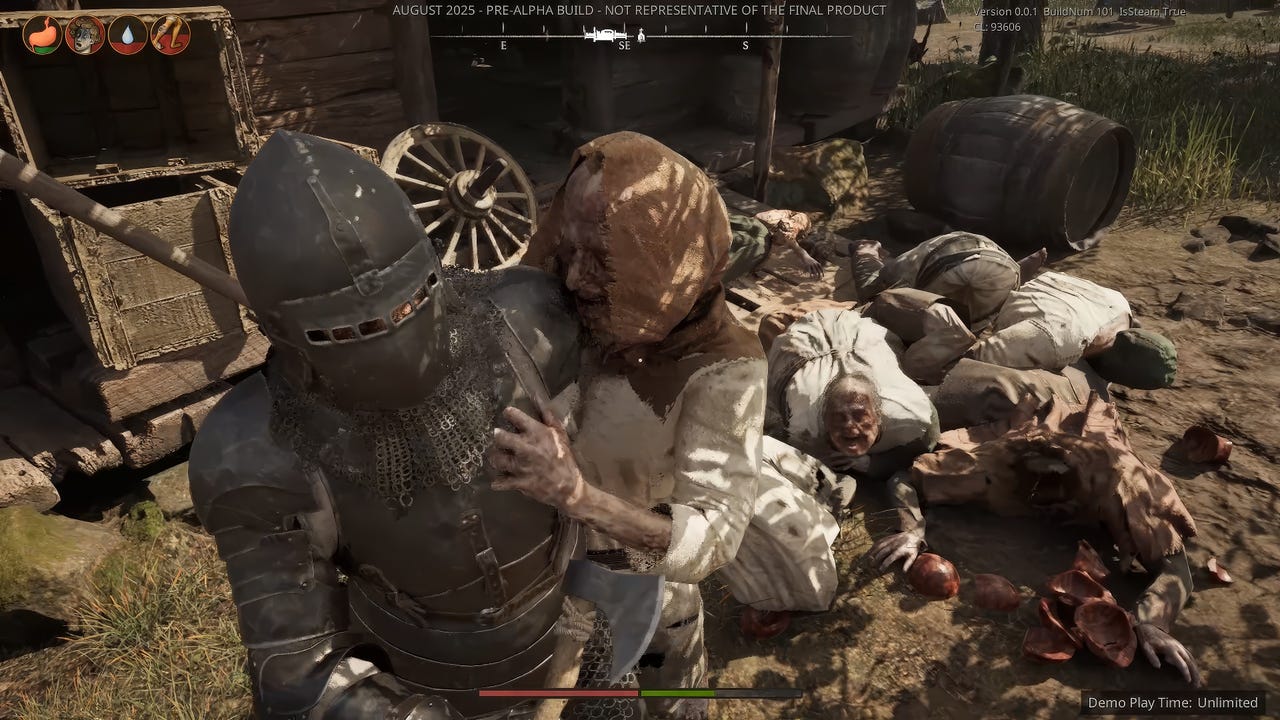
The zombie apocalypse seems like a known quantity in video games at this point, but God Save Birmingham hopes to throw the genre on its head. In my two half-hour sessions spent in the rotting village of Birmingham at PAX East 2026, I found that the medieval setting and timeframe, the hyper-dangerous infected menace, and the slow pace for scavenging and crafting do indeed make for a new sort of survival experience. It was buggy, as to be expected with pre-alpha builds at conventions, but very unique and promising.
Choosing Birmingham as a setting was a process led both by personal interest in fantasy set in the time period and economical factors. “They looked at London, Paris, all the capital cities were like, ‘These are way too big’ [to recreate faithfully],’” said Game Operations Manager Guinn Kim, who was working the booth for developer Ocean Drive Studios, about the process of finding the right setting. So scaling down to midsize settlements with a manageable geographical footprint (about a kilometer long in the 1300s) but also rich history dating back to the middle ages brought them to the Venice of the North. And a feasible population, which is important because Ocean Drive hopes to turn all roughly 6000 people who would have lived in the city at the time into zombies.
God Save Birmingham – Gamescom 2025 Screenshots

The piece of the city open to us, which is about a fourth of the size of what’s planned in the full release, was dense with derelict houses and buildings, all an approximation of what Birmingham would have looked like back then. “It’s trickier to recreate exact locations with such history,” Guinn said. “But the creative director visited the city and worked with local museums and historians to get it right.” Part of the issue is that the landmarks that might be identifiable in some sense by people from the area don’t resemble their ancient forms anymore. For example, St Martin’s church is roughly the place it should be on the map, but it is modelled after what it looked like before it was burned down and entirely rebuilt.
God Save Birmingham’s first big switch-up on the survival formula is that you can’t make the necessary tools to start turning trash into treasure. “
Most survival games ask you to start completely from scratch to build yourself a bunker, from grass and sticks to build your first tools all the way to zombie-proof fortresses. God Save Birmingham’s first big switch-up on the formula is that you can’t make the necessary tools to start turning trash into treasure. In order to turn derelict wooden carts into kindling and lumber to make fire or other wooden objects, you’ll need to find an axe among the plague-ridden barns and backyards of your former neighbor’s shanties. Easier said than done when the shambling dead are around.
Scavenging essentials for survival becomes a task just as harrowing as not getting mauled to death by your former countrymen. Food is pretty abundant if you look in the right places, like kitchens and store rooms where sausages, bread, cheese, and herbs would likely be. Water, on the other hand, is desperately scarce. In the map section available in this demo there were two wells, neither of which I could find as they weren’t landmarked all that well and also likely surrounded by hordes of undead that deterred me from investigation. I got lucky and found food that provided some quench for my thirst as well, but other factors I needed to consider, like washing myself so that my stench didn’t attract the mob, had to go ignored. I don’t think 30 minutes, which translated to most of a whole in-game day-night cycle, was enough to really notice the consequences of being stinky, though.
Finding clothes and starting fires to keep warm and especially a safe bed to rest in were the toughest of my survival goals. In other games in the genre, finding shelter is normally a matter of building something semi-permanent from the ground up, but God Save Birmingham didn’t feature any construction of the like. Instead, securing shelter meant finding one that’s already standing, clearing all of its undead squatters out, and fortifying the entry and exit points. And the more I think about it, both at the time and since, I’ve really come to appreciate this wrinkle. So many survival games, from Valheim to 7 Days to Die, feature a base-building aspect that can serve to minimize the survival aspect by turning players into a homesteading everyman. But here, the best you can do is make the most out of what already exists, which is a lost but ever-important concept in post-disaster works.
The key to securing a shelter in this way is by barricading doors by literally picking up objects and placing them in the way, a mechanic inspired by VR survival sims. Stacking empty footlockers, barrels, and furniture in a doorway will stop the plagued menace from getting inside. Piling objects outside of a building can create an impromptu staircase to get to the next floor up from the outside. The physics in God Save Birmingham are also such that dropping these objects from high elevation onto zombies below creates an appropriate Looney Tunes-level of slapstick violence. Zombies can trip over low rise walls and fences in pursuit of you, or you can pick up a wooden bench and swing it at their legs, tripping them in the process. You can also throw objects at them, my favorite being wagon wheels, as they provide a truly satisfying thunk on contact.
Remember that wood axe from before? It makes a great zombie processing tool as well. These medieval shamblers aren’t too dangerous alone, but become a real issue in groups, and they’re almost always in groups. Zombies can also be pretty durable. Swings from sharp blades can delimb them, which can hinder them but not render them completely harmless. On the other hand, a well placed blow to the head can end a skirmish in a single swing. This kind of body part-relevant damage targeting is a level of detail usually left for single-player zombie shooters like Resident Evil, so to see that kind of tactical flexibility here was great. Aiming for an outstretched arm with an axe and lopping it off before it grabs me or poking at a lead leg with a pitchfork to trip an incoming enemy is oftentimes better than hacking at a single foe until they stop moving.
This is specifically because of the unique way that zombies grapple you. They initiate a sort of grapple condition, slowing you down to a crawling speed as you attempt to shake them off. If you’re quick enough, you can push them back and make some distance to escape. This sounds similar to when a zombie might attack Leon Kennedy, but instead of a quick time button press to send your hatchet on an express trip to its face, the most you’ll do in God Save Birmingham is create separation. This grapple state is dangerous because as other zombies can’t necessarily join the initiating grabber (though that seems to be a future goal, according to Guinn), the time it takes to free yourself is just long enough for enemies to surround you. In my first playthrough, I got cornered by half a dozen, and struggling out of one’s clutches freed me just long enough to pass directly into another’s waiting arms. They may not be doing damage with these attacks, but they’re draining stamina, and when you become too tired to fight them off any longer, well…you know what happens next.
If you’re quick enough, you can push them back and make some distance to escape. This sounds similar to when a zombie might attack Leon Kennedy, but instead of a quick time button press to send your hatchet on an express trip to its face, the most you’ll do in God Save Birmingham is create separation.“
Fortunately, I was never just outright killed by the fiends in either of my playthroughs. Instead, the scratches and bites they managed to lay on me all had a chance to get infected. And if you don’t treat the infection in a timely manner, you will drop dead eventually, as I did attempting to barricade myself into a bedroom in the top floor of whatever passes as a swanky manor in 14th century Birmingham. It was difficult to tell which of the many conditions that populated the hud were ones that I needed to prioritize by lethality, as some of them are just obtuse looking facial expressions that look pretty bad, but appropriate in context of the horrors you’re traipsing through. In fact, those horrors plan to become a factor in and of themselves in the future. “One of the things the team is thinking about adding is Guilt,” Gwinn revealed, connecting the mental stress that a regular person who now has to kill his neighbors to survive might feel to some sort of mechanic that can make reality around you less and less reliable. “All in service of making a hardcore survival experience.”
Whenever God Save Birmingham hits Early Access, I’m confident that it will, for better or for worse, be unlike any game in the genre you’ve played before it. Its commitment to the grind of survival, the unique ways zombies swarm and infect you, the physics and object manipulation, and the medieval setting all combine to create a novel experience that begs to be experienced.
Jarrett Green is a longtime contributor to IGN. Say hello on X @Jarrettjawn.