
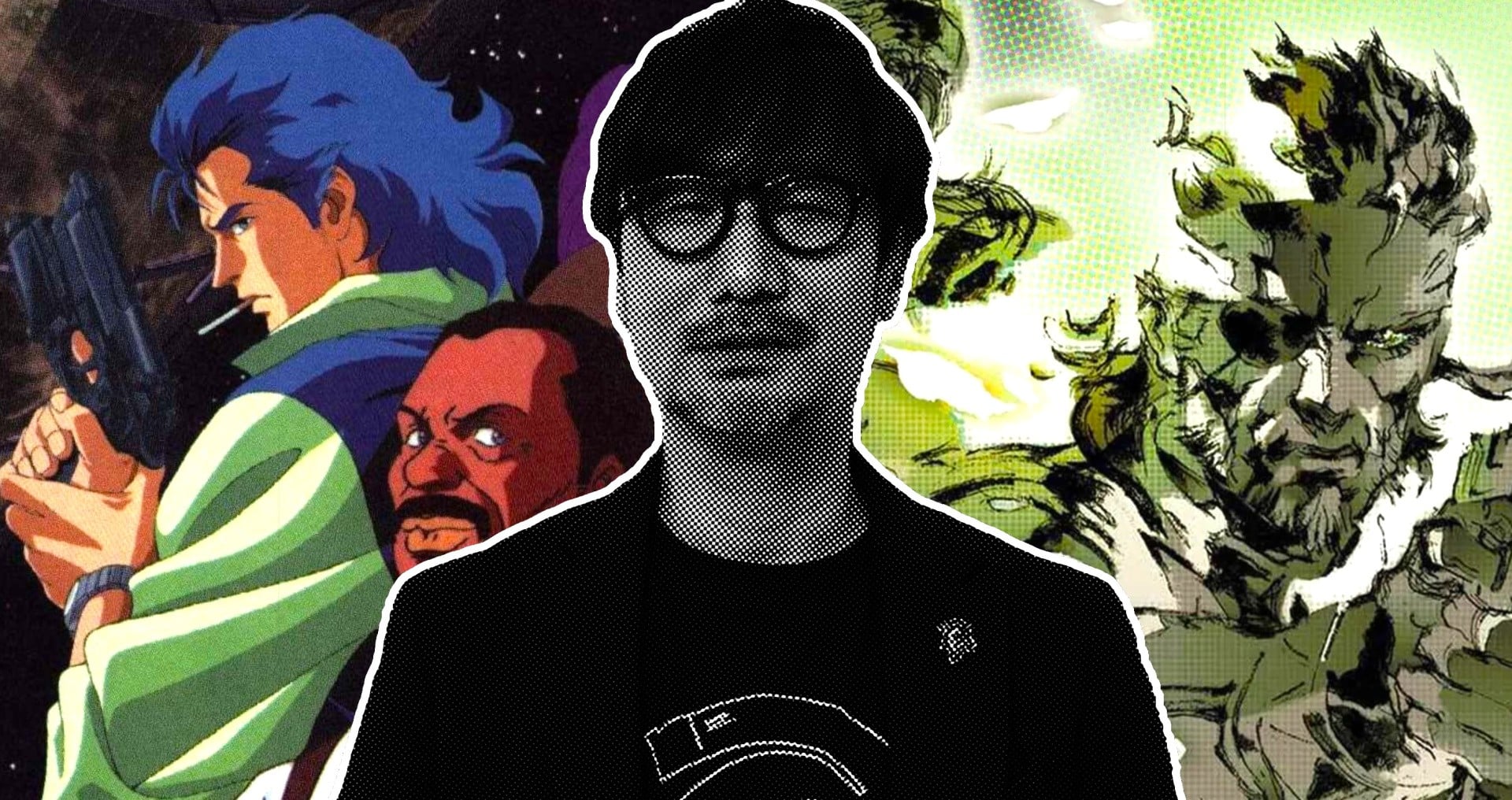
There are few game developers as influential, internationally well-known, or renowned as Hideo Kojima.
He transcends regional boundaries, languages, hardware platforms, and has a portfolio dating back nearly 40 years. Online, you will find innumerable interviews and thousands of deeply analytical op-ed essays. In fact, there are even books about Kojima written by Kojima himself. The question becomes: what else can be said about such a mythical figure?
You already know who he is and, probably, have already read several interviews. But, for many outside of Japan, awareness of Kojima’s name only began with the arrival of Metal Gear Solid on PlayStation (1998).
While his original Metal Gear on MSX2 (1987) had a European release, and its NES port reached America in 1988, neither celebrated the original auteur. The same happened with Snatcher on Mega / Sega CD (1994 / 95). In 1996, there were two exquisite spreads in DieHard GameFan, showcasing the PlayStation remakes of Policenauts and later Snatcher, and again, Kojima’s name was absent.
In 1998, his name was elevated through a heavy media campaign outside Japan, culminating in universal praise for Metal Gear Solid upon release. Electronic Gaming Monthly #113 gave it perfect review scores of 10/10/10/10, whereas Famitsu #508 gave it 9/10/9/9. There’s no real difference between 37 and 40, but the American magazine chose to make a symbolic statement through its perfect score. Keep this in mind, because it’s entwined with how Kojima’s meteoric rise leaned towards markets outside Japan (in Russia there’s even a meme cult around him). As we’ll also see, his influence from cinema (predominantly American) resonated strongly in regional markets, increasing his appeal and universality.
Metal Gear Solid was a masterpiece. Among many high points were the fourth-wall-breaking interactions: Meryl’s codec on the game packaging, save files for other Konami games being recognised (Kojima also wanted games from other developers), swapping controller ports to confuse Psycho Mantis, receiving a massage from Naomi, plus other examples. We labour the point of these because they transcend games as a medium and, as we’ll show, were always present in Kojima’s mind, while his contemporaries fail to get anywhere close to such things.

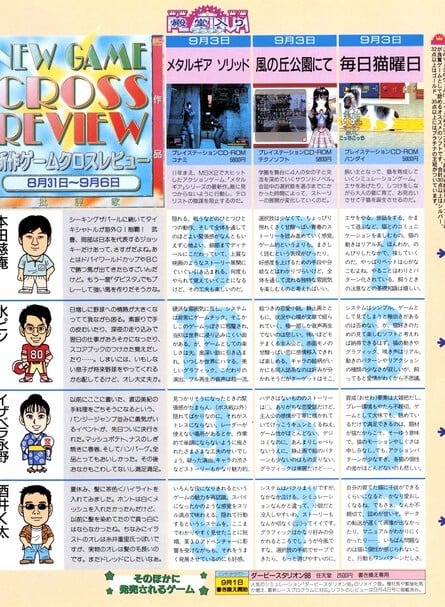 EGM (left) and Famitsu (right) review Metal Gear Solid — Images: EGM, Famitsu
From this moment onwards, the Western perspective shifted on his games, with the man himself in the spotlight, scrutinised in microscopic detail. This feature will explore his early portfolio and the media that defined Hideo Kojima, shaping his creativity.
We’re focusing mainly on games, rather than film influences; if you want a documentary examining his childhood and upbringing, the beatings he received at the hands of his father, and the trauma of his father’s death at an early age, this video covers the human side of Kojima. He’s a layered and complicated figure, but we’re aiming to frame him through magazines and computer games he made, and the games he specifically mentions as important. Through this framework, we intend to show that within his field, Kojima is unparalleled. Specifically, we’ll show that the unique qualities of Metal Gear Solid were actually present in his work from day one.
Kojima’s Computer Background
An important point is acknowledging that up until Metal Gear Solid, Kojima was predominantly involved with Japanese personal computers, both developing for and playing them – this is important because of how poorly documented Japanese computer history is compared to consoles.
Over the years Kojima has repeatedly stated his top four games which had the greatest impact: Super Mario Bros. for showing the possibility of action games; Another World for exemplifying authorship; Xevious for showcasing worldview; and Portopia Renzoku Satsujin Jiken / The Portopia Serial Murder Case for its story. In all of them, he describes feeling the potential of the future. In addition, he also cites Hydlide on computers, saying he was shocked at its open-world, and hoping he could elicit similar emotions in players with Metal Gear Solid V: Ground Zeroes.
Mario and Another World are both well documented in English; Xevious is also well known amongst an older generation of Western arcade goers. But outside Japan, Portopia is discussed mainly among hardcore cognoscenti, while Hydlide tends to be misunderstood completely, often stripped of context and chronology.
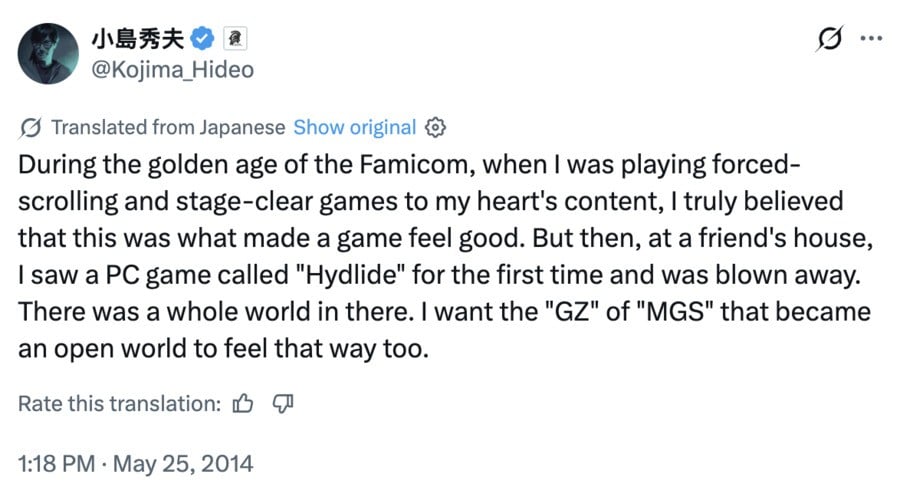 Image: @Kojima_Hideo
Part of this is due to the US-centric nature of many games historians. Hydlide, for example, is often trashed by US essayists as being inferior to The Legend of Zelda – but this is only because its US release came two years after Zelda, whereas in Japan it came out two years earlier.
Hydlide hit Japan in 1984 and then the US in 1989, five years removed from its proper context; this time delay sadly affects all Japanese pop culture sent abroad. In Japan, however, Hydlide sold a million copies across eight computer formats, was a revolutionary phenomenon in its time, caught the attention of Kojima, and influenced the MGS series.
While Kojima directly cited Hydlide for the open-world of Ground Zeroes, with Portopia, he actually hid the game within! Fans have discovered parts of Portopia’s game code within Ground Zeroes and Phantom Pain, which is a rabbit hole so deep it eclipses this simple feature. But online, you’ll find enthusiasts combing through data trying to solve the mystery, speculating that the PC-6001 version of Portopia might be contained within, and their desire to extract and play it, in case it’s been altered and hides a secret.
Although Kojima specifically mentions playing the Famicom port of Portopia, it’s worth looking at every computer version, since it not only influenced Kojima, but it’s also one of Yuji Horii’s earliest games, and thus a foundational ancestor to the Dragon Quest series and the JRPG genre itself.
When we talk about the importance of preservation, we mean this. Contemplate for a moment: one of the world’s most important developers specifically citing old Japanese computer games in relation to a modern release. It’s important to understand Portopia and Hydlide not just as floppy images in an emulator, but every aspect of them: packaging, manuals, maps, the magnetic disks, physical anomalies (some floppies had holes drilled to prevent copying), all of the data within, including hidden files, plus magazines of the era.
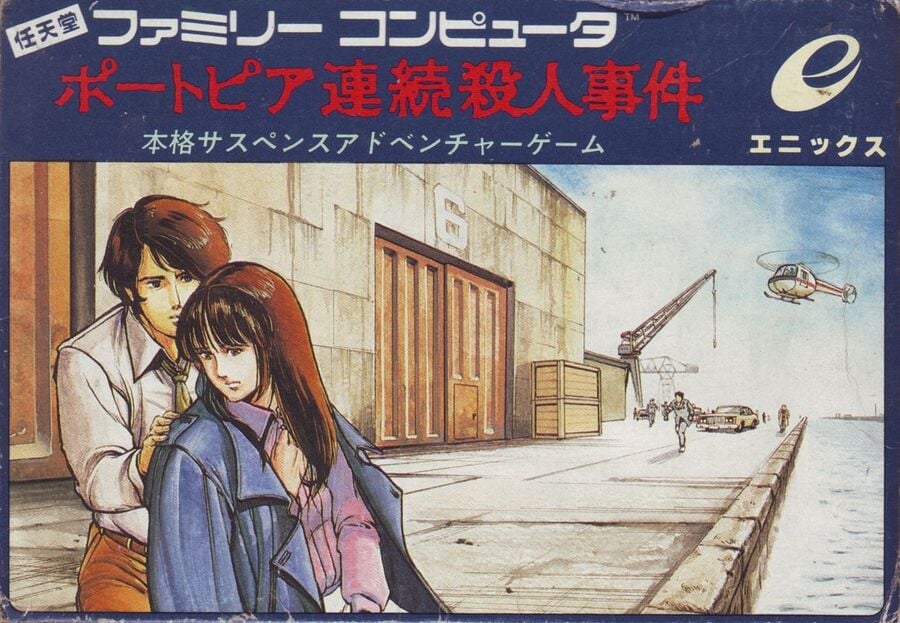 Portopia Renzoku Satsujin Jiken / The Portopia Serial Murder Case — Image: Enix
We should holistically consider the context which inspired Kojima, the zeitgeist within which he experienced these games. There exist detailed archives of both Portopia and Hydlide, and thousands of other games, and now any scholar can study these games and understand how they shaped Kojima. Or any other Japanese creator; there exists a framework for understanding their thought processes. By dissecting the games Kojima grew up with, we are, in a way, conducting an archaeology of his mind.
We can trace the influence of these games back even further. Hydlide’s creator, Tokihiro Naito, was influenced by Tower of Druaga. Shigeru Miyamoto, with The Legend of Zelda, was also influenced by Druaga, as was Yui Tanimura of From Soft, with regard to the messaging system in the Soulsborne series. Ergo, when you read the words of developers, you can see how Breath of the Wild, Elden Ring, and Metal Gear Solid V all have shared, traceable roots.
Digging through Kojima’s portfolio offers its own kind of digital archaeology, and starting with his first-ever work (uncredited) sets a precedent maintained to this day. You will find no better write-up on Yume Tairiku Adventure / Penguin Adventure (MSX) than this one. Its author, Time Extension contributor Ashley Day, states:
“It feels like each stage introduces something new. Penguin Adventure is an entire game of brilliant little moments. It’s all about the Easter Eggs. You might even say that the real objective is to discover them all. It’s no exaggeration to say I consider it the Super Mario Bros. of the MSX.”
Now, Kojima himself has been keen to stress this was not his directorial debut, and he only contributed some gimmicks and other ideas. Without a clear delineation of who was responsible for what, it would be unfair to attribute praise for the plethora of brilliant moments solely to Kojima.
But when you examine Kojima’s works which came after, and see the richness of ideas, you can then view Penguin Adventure and feel the unmistakable sensation of Kojima’s “spirit” within. It doesn’t matter even if his actual input was minimal; his first project was one stuffed with so many ideas that even if they’re mostly attributable to colleagues, the key point is that his “training environment” encouraged this style of inventive creativity.
 Penguin Adventure — Image: Konami
Next, Kojima would work on Lost Warld – the second word being a portmanteau of “war” and “world”. This would see significant work done, including opening and ending cinemas, bonus stages, and more, but would go unreleased. It actually started using leftover assets from a cancelled wrestling project called Masked Fighters.
In 2012, in an interview with Julien Chièze, translated by Florent Gorges, Kojima explained:
“The project was already in progress, a wrestling game, but unfortunately it was cancelled mid-development. Given the characters were well designed and animated, I asked myself if it was possible to use these for something else. For a month I tried to think of another game. Then, because I was a new employee, they asked me to do an internship. When I returned the game had changed and the main character became a woman. It became a platform action game, and I prepared a script and ideas on 200 to 300 pages. We worked on it for three months, but it was really ambitious, so it was cancelled. After that I created Metal Gear.”
He’s been asked about Lost Warld in various other interviews, including Game Maestro Vol. 2 and Famitsu. It was to have an Indiana Jones-style theme, at one point involved survivors from the Titanic, and generally took the shape of a Mario-style platformer, the ambitions of which exceeded the hardware and ROM capacity.
In Game Maestro, he says of the cancellation: “It was the biggest disappointment of my life. I thought I was going to die.” Thus, we can regard Lost Warld as a vital missing puzzle piece, something the young developer threw himself into to make an impression. The fact that all that work was lost is heartbreaking even 40 years later; whether it would have been any good is irrelevant, it was part of his maturation process at Konami and worth studying.
All The Gear, And A Great Idea
Next came Metal Gear (MSX2), the seed which would define Kojima for decades. The irony is that it was not his game; it was a failing project within Konami, which he was assigned to, and through ingenuity and acceptance of the MSX2 limitations, he crafted something distinct.
In an interview with Nice Games from 1999 he explained:
“The development had a troubled history. Several Konami veterans had been working on this war game for two years. But it wasn’t going anywhere: they’d create something, scrap it, create something, and scrap it again. There was a legend at Konami, if you got involved in this project you’d end up demoted. (laughs) I have no idea why they kept continuing it.”
It’s never been revealed who actually started this project (its internal Konami development codename was N312), or what previous iterations entailed, but it doesn’t matter. Kojima took the design brief for a “war game” and made something wholly his own, eschewing combat in favour of stealth. The origin of the stealth genre can be traced back to Manbiki Shounen in 1979, but Kojima’s landmark 1987 release was an evolution which standardised various elements.
You can also start to see Kojima’s reverence for film and integration of real-world happenings. He’s described his film influences often, including The Great Escape when making Metal Gear. It’s also set in South Africa, which is interesting when you consider the political and news climate Kojima would have been exposed to in Japan in the 1980s.
 Metal Gear — Image: Konami
Not only were there a slew of action films featuring mercenaries in Africa, but South Africa at this time was engaged in a border war taking place over areas of Namibia, Zambia, and Angola; often called the Angolan Bush War, this has been described as South Africa’s equivalent to the Vietnam War, and also involved mercenaries.
Japan and South Africa at this time also had a special trade relationship, defying international sanctions, resulting in the Japanese being given “honorary white status” under Apartheid. The two nations were very close. You can find plenty of legacy news footage online; if Kojima at any point flicked over to NHK’s international news, he would have been aware of events. Later, with MGSV, some characters actually spoke Afrikaans, one of the official languages of South Africa.
Also, while not written by Hideo Kojima himself, and based on the Famicom port of Metal Gear rather than the MSX2 original, we want to draw your attention to Konami’s adventure book based on the game. Acting as a playable sequel, this is one of 243 known adventure game books in Japan which are based on video games.
Snatcher followed and would be Kojima’s attempt at an adventure in the style of Portopia, albeit with a heavy dose of Blade Runner, Terminator, and even a bit of Dune thrown in. Originally, it was called “Junker”. The development was comparatively large for the time and has been described as stressful. The two initial versions for the PC-8801 and MSX computers were also cut short, on a cliff-hanger, with the final act only added when ported to PC Engine and then Mega CD. Although described as a digital comic by many, it contained a lot of innovative ideas, including shooting segments.
The most intriguing idea, though, is one that had to be scrapped. As Kojima describes it:
“I wanted to include a gimmick or surprise when changing disks. You go to a murder scene in Snatcher (PC-88). The floppy disk gets hot from the heat inside the computer. So I printed a ‘dying message’ on the surface of the disk using paint that changes colour with heat (mixed with iron components). You smell blood and when you pull out the disk, the message appears.”
The phrase dying message refers to something written just before someone dies. Although never implemented, this is the sort of idea Kojima would become famous for. It’s understandable Konami didn’t sign off on the idea, but it’s fun to look at the floppies and ponder: what if?
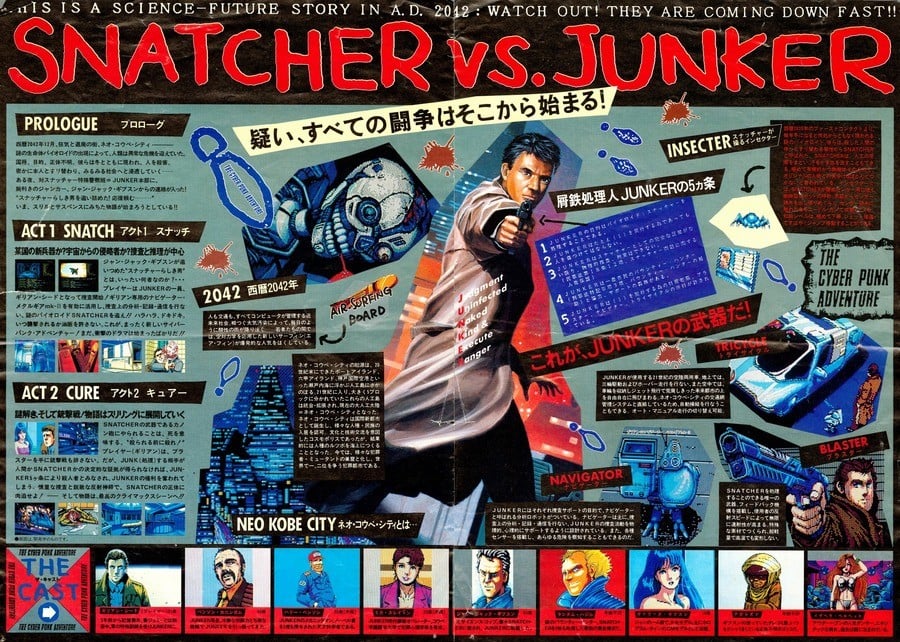 Image: GPS / Joseph Redon / Konami
The continuation of the Metal Gear series, with Metal Gear 2: Solid Snake (MSX2), was again spurred on by events outside of Kojima’s control. It began with the NES sequel, Snake’s Revenge; an extremely competent game which would feature multiple elements found in later entries, including a ship full of Metal Gear units. Sadly, it’s criticised by fans upset at not receiving the MSX2 sequel.
Regardless, Kojima himself felt it was authentic during this interview with Gamers Today. He explained:
“This guy in the Famicom division developed Snake’s Revenge. One day he and I hopped on the Tokyo transit system together. We’re talking and he says, ‘By the way, I’m developing Snake’s Revenge, but I know it’s not the authentic Snake, so please create a new Snake game of your own.’ That was when I decided to create MG2:SS. I thought [Snake’s Revenge] was very faithful to the Metal Gear concept. I enjoyed it.”
Although not named, the colleague was most likely Hitoshi Akamatsu, an important figure at Konami who, despite much searching, has not been traceable in recent years.
The melancholy fate of Solid Snake, forever embroiled in machinations beyond his control, seems to reflect that of the series creator. First, Kojima was assigned someone else’s failing project, and now he felt a sense of obligation to make a true sequel. Not only is MG2:SS a fantastic game, but it would also become the template for later instalments.
In many ways, MGS on PS1 plays like a 3D remake. Remember how we referenced the Meryl box frequency as being representative of Kojima’s meta-game genius? His idea actually started here in 1990: Campbell will change frequencies and instruct you to look at the back of the MSX2 box! We also see Kojima’s love of TV coming through: at one point, Snake must use chocolate to neutralise acid, mimicking the 1985 pilot episode of MacGyver.
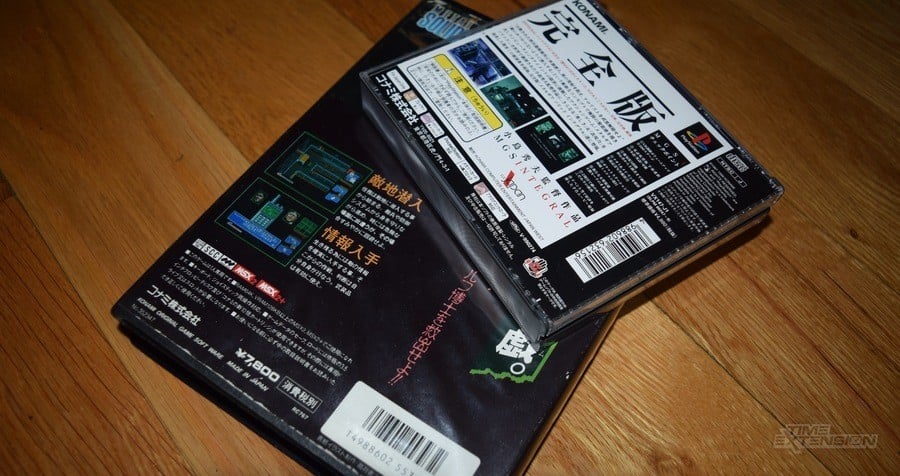 The ‘Codec-on-the-back-of-the-box trick’ wasn’t pioneered by MGS; it made its debut with Solid Snake on MSX2! — Image: Artemio Urbina / JunkerHQ / Time Extension
Policenauts followed, and its four-year development was even more harrowing than on Snatcher, with its PC-98 launch being rather inconspicuous. Interestingly, when work began in 1990, they wanted to label the game’s genre as “Cinematic Virtual Reality” – at the time, there were no similar trademarks registered. By the time Policenauts was finished and ready for release, the phrase “Virtual Reality” had been trademarked, so Kojima dropped the idea. Most who know the game will know its 3DO, PS1, or Saturn ports, which is unfortunate since the PC-98 original is stunningly beautiful, with exquisite high-resolution pixel art, despite a lower colour palette.
It’s interesting to note that many of Kojima’s fans will have been born after the millennium and, being in their 20s now, might not even be aware of his earliest works such as Policenauts. Even if they know the name or have played the fan translation, their cognitive frames of reference will likely miss the nods to various 1980s films, such as Lethal Weapon.
For those who grew up in the 1980s, the referential shorthand Kojima employs in all his games (visuals, thematic, linguistic, etc.) will be instinctively understood; it raises the question of how newcomers will react to and interpret these earlier works, which rely on a familiarity with pop culture from the era.
Images: HG101 / Charlie Johnson
Equally, in recent years, an overly sensitive and vocal minority on social media have taken to pathologising the previously healthy behaviour of men being attracted to the female form; given that certain players struggled to appreciate the artistic beauty of Quiet in MGSV, are they capable of enjoying Policenauts’ more playful elements, which border on ecchi?
This shift of attitudes and schism between generations is important when discussing Kojima’s success. Those born after the millennium need to understand the DNA of Kojima through an older worldview, where innuendo was encouraged, and specific films were part of cultural discourse. In truth, comparisons to Lethal Weapon are a little overdone, since it’s mainly the aesthetics of the two lead characters; Policenauts dark sci-fi conspiracies are the diametric opposite to the urban buddy-cop comedy of Lethal Weapon. Far more interesting are influences from the 1978 film Coma – click and scroll down to see just how influential.
Although it came after MGS, and we want to focus mainly on his pre-MGS years, the handheld Boktai series is too unusual not to mention briefly. Making use of an excess of UV light sensors, which were integrated into the Game Boy Advance cartridges, the Boktai series featured an in-game clock and required you to play in real sunlight to charge up your weapons.
For all the talk of clues on game packaging and secret blood messages on floppies, this feels like the quintessential Kojima game. Where the core mechanics are integrated directly into real-world variables. In this way, Kojima redefines what a video game is, making the object itself an artefact to be interacted with.

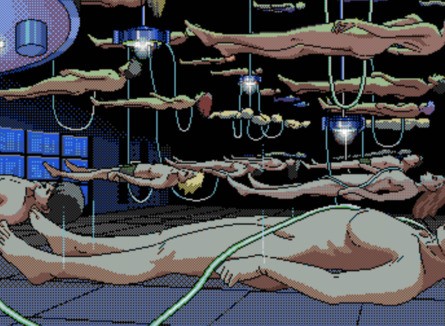 Michael Crichton’s 1978 movie Coma (left) and Policenauts (right) — Images: HG101 / United Artists, HG101 / Charlie Johnson
Again and again, Kojima has noted how his bold and innovative ideas, when presented to colleagues, have not been understood. He describes how almost no one understood Metal Gear’s avoidance, or how an adventure like Snatcher could have shooting, or the survival mechanics in MGS3: Snake Eater, or Boktai needing sunlight. He describes how it can take years before such originality is appreciated.
There’s a lot to unpack; it seems like people in game development (or perhaps just management) lack imagination. But it also speaks to the creativity Kojima has bottled up, with some of his unrealised ideas being his most interesting.
In GamesTM magazine #27, and Official PlayStation 2 Magazine #1, and again on GameSpot, Kojima has described his idea for a “namage” or “raw game”. The idea is that you can theoretically play the game for several years, but when you get a game over, it self-destructs or deletes itself and cannot be played further. You would have to rebuy it to play again. The concept had already been seen in 1986 with Sub Mission: A Matter of Life and Death, though unsurprisingly, the idea has rarely been revisited. There was Lose/Lose in 2009 and One Life in 2015, but nothing of the ambition described by Kojima.
Not too long ago, on his radio podcast KOJI10, episode 17, Kojima discussed several unusual ideas. One involves controlling a character who grows and ages, becoming physically weaker as they become older, but having greater wisdom. Another was for a game to be played quickly, since the main character would forget important information and even skills/abilities if players took too long. Which calls to mind MGS3:SE, and the infamous fight against The End; if you save mid-battle and then reload your save after the PS2’s internal clock has lapsed a week, The End dies of old age.
Games Are Better Than Movies
Although Kojima jokes that his body is 70% movies rather than water, and essayists repeatedly analyse him through the lens of someone who should be making movies, this is actually an overblown claim.
In an interview in Electronic Gaming Monthly #258, Kojima categorically stated the benefits of games over film, their greater complexity, and how he’s come to prefer them:
“Film-industry people tell me that shooting a film is easier than making a game, because the director has control over chronology, camera placement, and so on. Directing a movie would be simpler than creating a game, with its necessary player interactivity and innumerable variables. I started making games because I was unable to direct films, but I soon realised the depth interactivity affords. So much can be offered only through the medium of games.”
Kojima, in stating the above, shows greater vision and insight than his contemporaries in games and rival mediums. Video games are the apex creation of humanity. They are the summation of everything which came before. Games can visually convey traditional hand-painted art, digital imagery, or “abstract light manipulation” as required. Recorded music can be played, or chiptunes can be generated electronically.
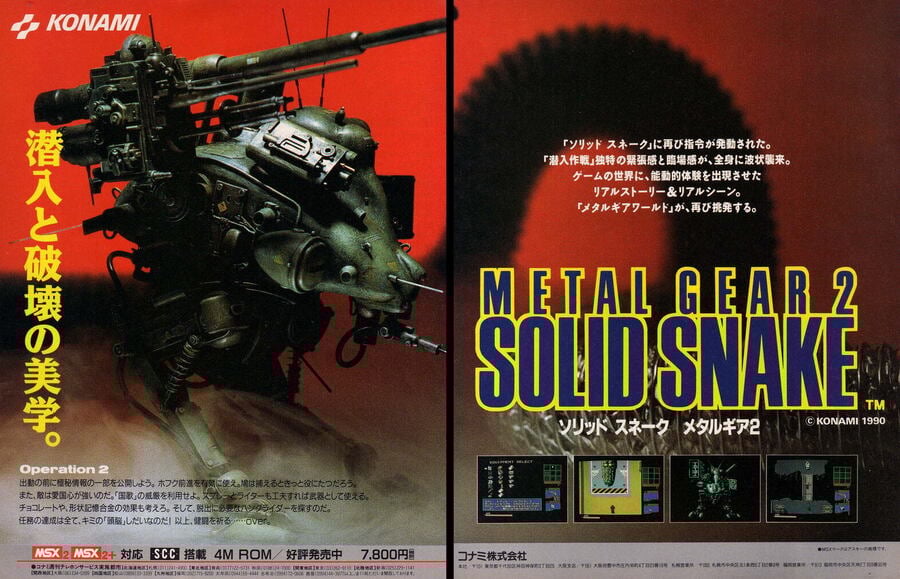 Image: Konami
Games can mimic millennia of known architecture, create structures previously unseen, or even envision things which are not physically possible, such as with non-Euclidean geometry. Newtonian physics can be replicated or played around with, expanding one’s understanding of reality. Economic systems and strategic models can be theorised and tested.
Games can be all things which already exist, and they can be things which no one could conceive of were it not for the existence of games. They are simply an infinite medium through which to express whatever the mind is capable of.
Think about everything we’ve just written about Hideo Kojima and how he embraces video games. Now contrast this with the vast ocean of people, for example, across the Game Developer website, all bemoaning the difficulty of working in games. Specifically note the comments of writers – several of whom have a background in TV and film, now making their way into video games – who unfortunately fail to understand what games are and are capable of. It is essential to look at specific examples because it reframes Kojima’s adaptability.
Images: HG101 / Charlie Johnson
Amy Claussen, a veteran writer with a background in theatre (follow the YouTube link and skip to 4:00), talks about narrative rules and following a prescribed formula, complaining that the games industry “messes it up”. With all due respect, this shows a complete lack of understanding of why games are unique and compelling. Adam Volk gives five reasons why game writing “sucks”, emphasising that it is a unique skill and not all writers are capable of it. Adam Maxwell suggests doing away with writers entirely and replacing them with game designers. It wouldn’t be unfair to suggest that talented writers from other fields don’t necessarily have the skillset to create compelling interactive (and non-linear) stories.
Kojima, despite his protestations, is better than all the film-makers he praises – at least in terms of ludology and having an understanding of gameplay mechanics, and how to integrate them with narrative in an organic and synergistic way, which doesn’t compromise the fundamental point of games, which is playing them.
Because make no mistake, were the roles reversed, few with a background in TV or film could conceive of the bloody floppy disks, games which delete themselves, radio frequencies on the box, or using actual sunlight to play with. Perusing the multitude of Game Developer write-ups should prove to you: throw a chaff grenade in any direction, and you’ll hit the head of someone who struggles simply with the inherent nature of a game being player-controlled.
In Game Maestro Volume 2, Kojima talks about magazine articles of the time discussing Metal Gear (MSX2), with them stating it was rare to see an action game with a story like a military novel. From the start of his career, Kojima was integrating rich multi-character narratives, not only without compromising the game itself, but also implementing fresh mechanical ideas and always intuitively understanding the nuance offered by games.
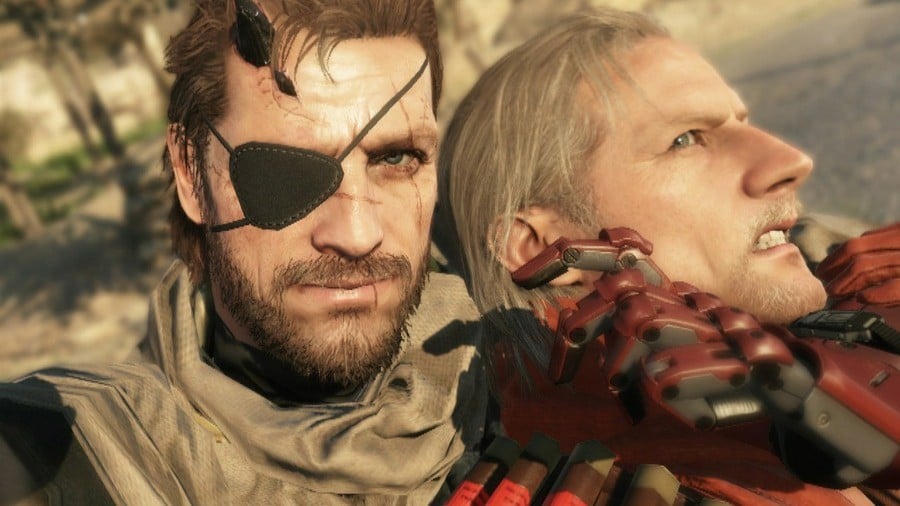 Image: Konami
Later with MGS, he not only wrote a compelling script, but took the time to build locations out of Lego in order to better understand the architecture of 3D games and the requisite camera angles. Few other developers are as immersed in the medium as Kojima. Perhaps Shigeru Miyamoto, who needs no introduction, and Peter Molyneux, for sheer wild ambition.
To experience a Kojima game is to glimpse beyond the preconceived notions of what artistic media is capable of. Both within games and outside, there’s not a lot to compare him to. One similar auteur might be Trent Reznor of Nine Inch Nails, who conceived of an “augmented reality game” for the Year Zero album, with USB memory sticks hidden in toilets and secret websites to discover, culminating in a faux-raid by SWAT at a covert resistance meeting for fans who deciphered it. The thing is, Reznor implemented this meta-reality idea in 2007; Kojima was conceptualising his own reality-breaking interactions at least 20 years prior.
Without question, Kojima deserves a seat within the grand pantheon of artistic visionaries, alongside other pioneers such as Trent Reznor, David Lynch, and William Gibson (read up on Gibson’s self-destructing 1992 poem Agrippa – it’s the sort of concept Kojima would love).
If we are to honour Kojima in this way, we need to understand how he reached this level, by exploring not just his own evolving portfolio, but also the games he enjoyed and was influenced by. These historical artefacts are the DNA that defines who Hideo Kojima is, and with various groups preserving them, they have forever ensured the ability for scholars to analyse said artefacts, and by extension, analyse Hideo Kojima himself.
Thanks to: Dustin Hubbard of Gaming Alexandria for helping with the Famitsu scan. Charlie Johnson for PC-98 screens of Policenauts. Artemio Urbina of JunkerHQ.net for providing interview scans and the photos of MG2 alongside MGS. Paul Loubser for consultation regarding Afrikaans.
Finally, thank you to the Japanese Game Preservation Society for its continued work and support.



John has been documenting video games since 2005. Former staffer at Imagine Publishing and Retro Gamer magazine. Author of The Untold History of Japanese Game Developers series of books. Its amalgamated hardcover, Japansoft, was translated and published in France, Russia, and mainland China. Has interviewed over 150 people. Keynote speaker at academic symposiums. Hobbyist programmer. Licensed RYA dayskipper. Not a fan of social media.