
Last updated on April 4, 2026
Steam Vents | Illustration by Yeong Hao Han
Please buckle up, you’re about to experience some turbulence.
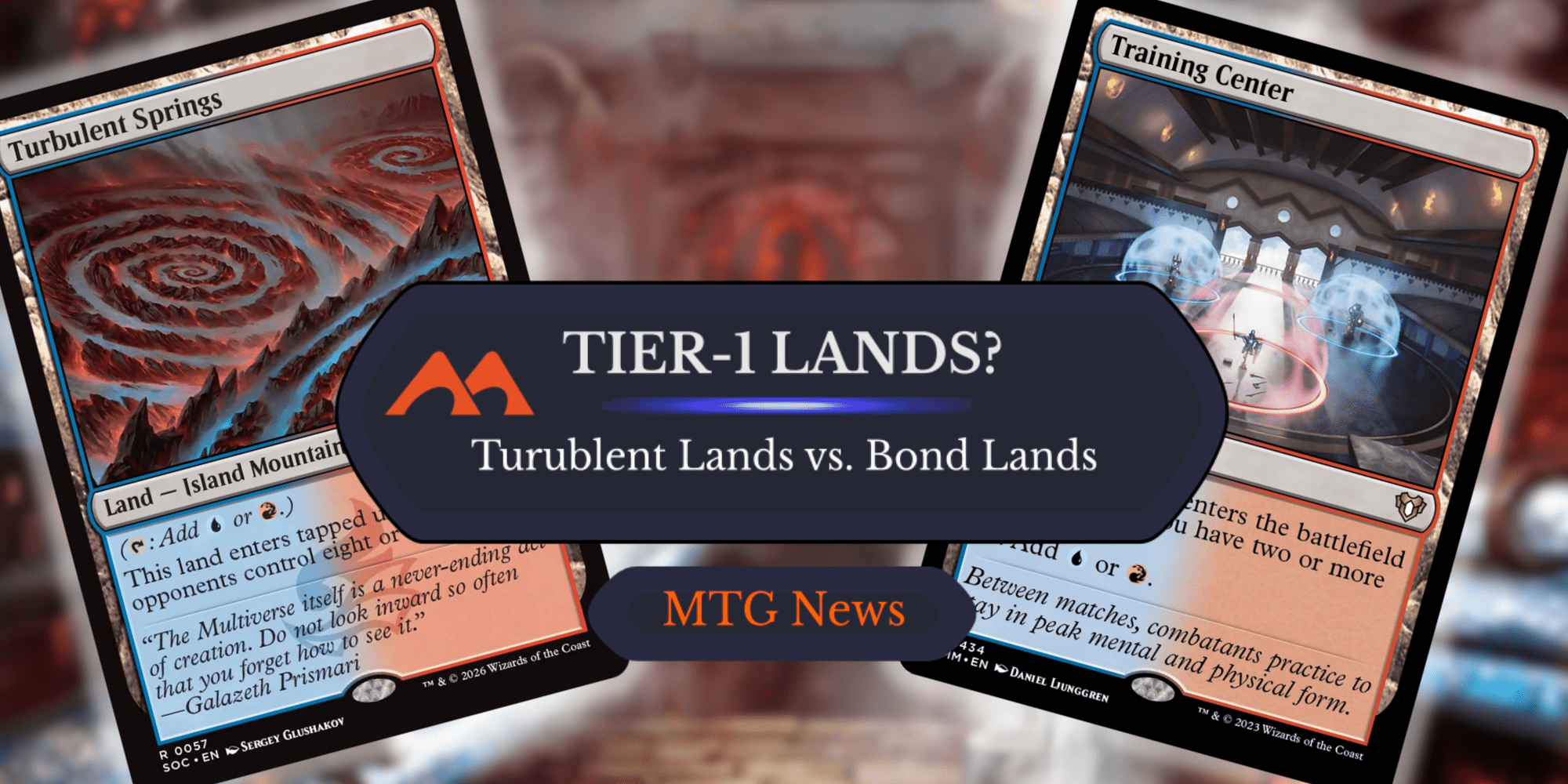
I’m not hearing a lot of buzz about the new Turbulent lands from Secrets of Strixhaven Commander, and yet, these might be some of the best lands printed specifically for Commander in years. But are they the literal best EDH-specific duals now, or is there another cycle that still outclasses them?
What Are the Turbulent Lands?
First thing’s first: What is this new land cycle, and where did it come from?
The Tuburlent lands were just revealed for the Secrets of Strixhaven Commander precons, with one dual land per corresponding color pair in Strixhaven. They each tap for one of two colors and have the text: “This land enters tapped unless your opponents control eight or more lands.” And most important of all, they each have their two corresponding land types, making them fetchable.
Let’s break down a couple scenarios to see how they work in practice, using turn 3 as a pivot point:
You play first in a 4-player game: If everyone hits two land drops in their first two turns, these lands will still be tapped on turn 3 unless multiple opponents hit extra land drops.
You play second: Two opponents have two lands each, and one opponent has three. Your Turbulent land is still tapped on turn 3.
You play third: Two opponents have three lands each, and the last opponent has two. Now your land’s starting to enter untapped.
You play last: These will almost always enter untapped by turn 3.
So, barring any horrendous mana screw, you can always expect these to be untapped from turn 4 onwards, and depending on your seat at the table, there’s a chance they enter untapped on turn 3. It’s possible they even enter untapped on turn 2, or turn 3 on the play if multiple opponents played Rampant Growth-style ramp effects.
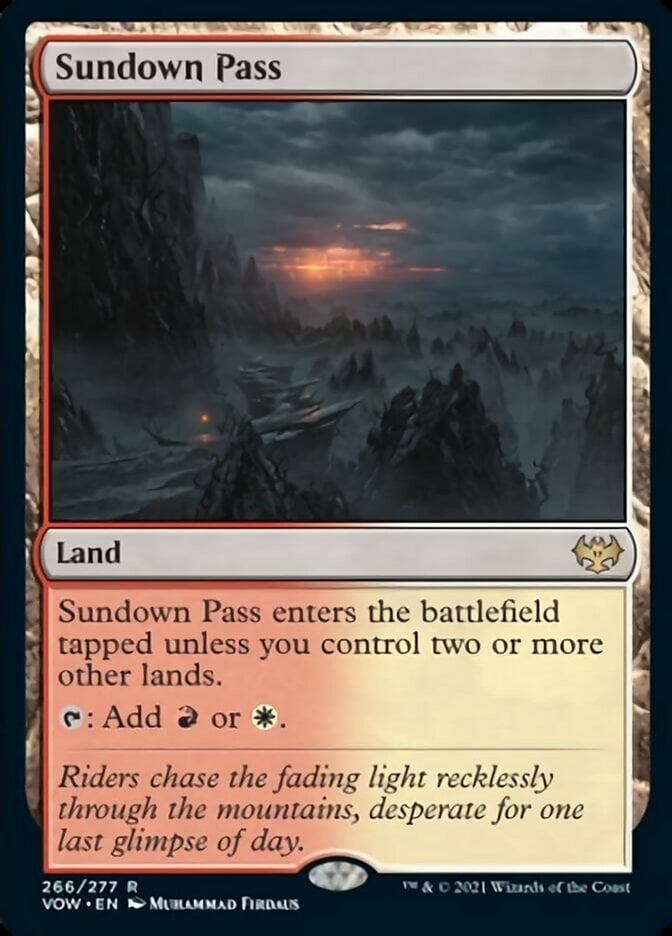
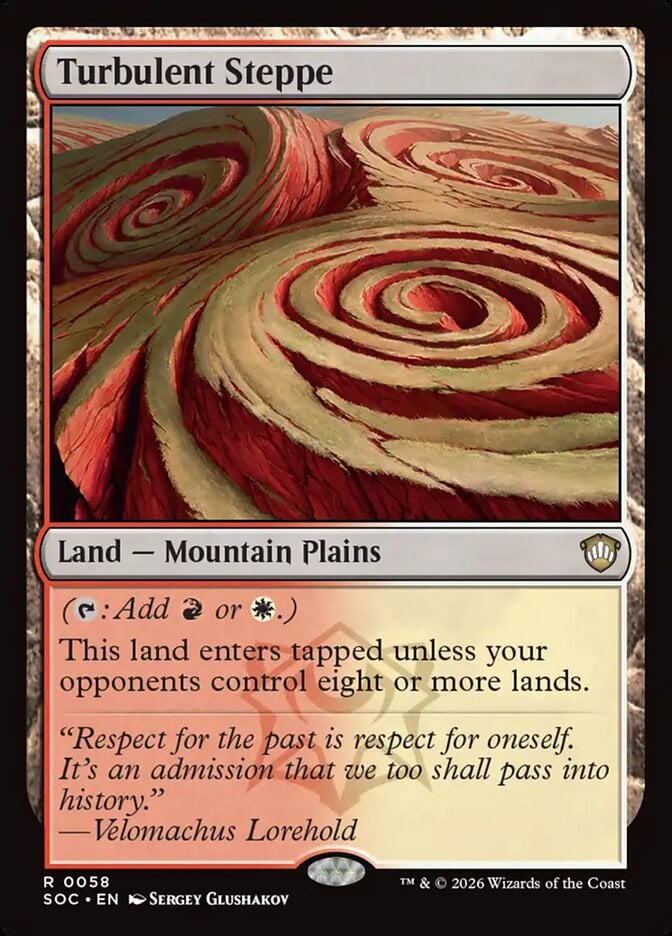
In practice, these should play very similarly to the “slow lands” from Midnight Hunt/Crimson Vow (also being reprinted in Secrets of Strixhaven). Sundown Pass always enters tapped as your first or second land, but always enters untapped as your third land and beyond. Similarly, Turbulent Steppe will almost always be tapped on the first two turns, and has about a 50/50 shot of being untapped on turn 3, after which it’s always untapped.
I actually really like that these lands are better the farther along in the turn order you are, since it’s a fairly painless way to get a tiny edge for playing third or fourth in a 4-player pod.
The Competition
Source
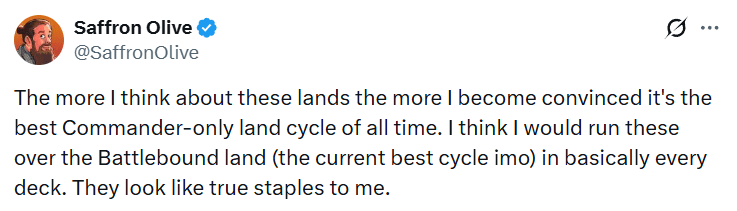
Credit where credit is due, this whole comparison piece was inspired by a tweet from @SaffronOlive, who claimed this could be “the best Commander-only land cycle of all time.” I hadn’t really thought too much of them up until that point, but it made me take a second look.
Just to be clear, Saffron Olive is talking about casual EDH here, since these lands are likely too slow for cEDH, and he specificed “Commander-only” lands, which is really just referring to the Bond lands.
Though the enemy colored “bond lands” actually originate from Commander Legends, it was Battlebond where this cycle first appeared, specifically with allied color pairs. Since their release, they’ve been some of the absolute best dual lands for Commander, just under all the best format-agnostic duals like fetches, shocks, and the original Duals.
So what Saffron Olive is really saying is: The Turbulent lands are better than the Bond lands, and that’s a question worth poking at. My initial reaction was “no way”, but it’s worth delving into. So let’s dig into the comparison and see which ones are actually better.
Tapped vs. Untapped

Vault of Champions | Illustration by Cliff Childs
The bond lands have the immediate advantage of being virtually always untapped in a multiplayer game, even on turn 1 and 2 where a Turbulent land will basically always come in tapped. The reverse of that is also true, where a Turbulent land will regularly enter untapped in the late game, but a bond land might actually enter tapped if you find yourself down to just one opponent.
The former situation is way more important. It’s essential to get your mana up and going as early as possible, and the bond lands never fail at this. They let you make turn-1 and turn-2 plays consistently, and the Turbulent lands might as well be guildgates during those turns, and sometimes even on turn 3. It’s also not really that big of a deal that bond lands might enter tapped towards the end of the game, since your mana’s probably well-established at that point, and a tapland rarely hurts that bad on turn 8 and beyond.
So if it’s a matter of immediate mana fixing, the bond lands win by a landslide. They have all the mana advantages of the Turbulent lands without the obvious downside.
But Turbulent lands have one key element that bondlands do not: land types. That’s the entire reason this conversation is even worth happening. There’d be no discussion without basic land types. But the fact that the turbulent lands are fetchable make them vastly more interesting to consider.
Making Fetch Happen

Flooded Strand | Illustration by Andreas Rocha
So, do those land types really push the land cycle to tier-1 status, even above the well-established bond lands? Let’s explore by seeing how impactful it is to fetch these at different junctures in the game.
Turns 1-2
I don’t really think the Turbulent lands’ fetchability matters during the first couple turns. Presumably, you’re playing these in tandem with other great fetchable lands, not as replacements for them. So in any situation where I’m going to fetch a tapland, I’m just going to get the corresponding surveil land for extra value or a triome for additional fixing. If I’m looking for an untapped land, I’m getting a shock, or the big ballers amongst you might get an OG dual.
Yes, Turbulent lands are fetchable in the first couple turns and bond lands aren’t, but there are better lands to be fetching in those situations anyway.
Turn 3
Turn 3 is the pivotal point for Turbulent lands, since that’s the earliest they’ll regularly enter untapped, depending on seat order and how your opponents ramped, if at all. This is the turn in which a Turbulent land seems better than a bond land, since you can sometimes fetch them untapped without incurring the downsides of other fetchable lands like shocks or tango lands (Canopy Vista, etc.). A bond land from hand is still better, but the advantage of the new cycle is pulling them from the library.
Turn 4 and Beyond
From this point forward, the two competing lands might as well just be the same thing. They’ll be functionally identitical if you play them from your hand, and while you can still fetch a Turbulent land as an advantage, you’re probably at the point where you could also just fetch a basic and be totally fine, so it’s unlikely to matter too much.
To summarize, there are some instances where a Turblent land is certainly better than a bond land based on fetchability, but the existence of other dual lands with relevant land types sort of mitigates those advantages, since those are better lands to get in situations where the Turbulent lands have an advantage.
Hidden Benefits
Of course, there are some additional benefits to having land types beyond just interacting with fetch lands. Turbulent Fen is a target for Skyshroud Claim, it counts towards domain, and it can be enchanted with Utopia Sprawl, to name a few examples. None of that applies to Undergrowth Stadium.
Still, I feel like this only really matters if you’re just not playing other typed duals in your deck. All of the above works just as well with Overgrown Tomb, Zagoth Triome, and Underground Mortuary, too. So the Turbulent land isn’t doing anything you can’t do with existing duals. And if you’re already playing these duals, you can supplement them better with the corresponding bond land instead of playing fetchable dual land #4.
I’m just not a believer right now. I bet these new lands are fine, but I don’t think “better than Bond lands” holds much water. Coming in untapped on the first three turns, no questions asked, is just so much more of an upside than being a fetchable land in a world of better fetchable duals.
Maybe if these end up being dirt cheap they’ll be a nice budget alternative to triomes/surveils/shocks, but I’m not ready to put these in tier 1 quite yet.
Follow Draftsim for awesome articles and set updates: