
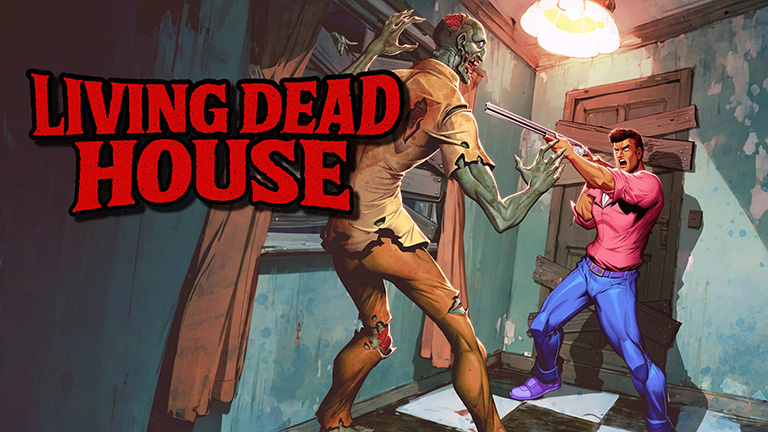
Like Donut Dodo, Cash Cow DX, Looney Landers, Goliath Depot, and Murtop, Living Dead House feels like an ‘80s arcade game that somehow got lost in time. Had this game actually been released during that era, I probably would have dropped a few quarters into it. But Living Dead wouldn’t have become one of my go-to cabinets. Despite a few innovative ideas, it doesn’t have the addictive playability of classics like Donkey Kong Jr., Bubble Bobble, and Ghosts ‘n Goblins.
Interestingly, the goal of Living Dead House isn’t to wipe out every on-screen enemy. Instead, Arcade Mode’s succession of twenty stages challenges you to survive the night. Each level runs on a timer, giving the game a frantic, evasive feel, with a tension between running away for safety and killing enemies for points. It’s a novel twist, though it’s not always a satisfying one.
Shoot, Swing, ‘Saw, or Run?
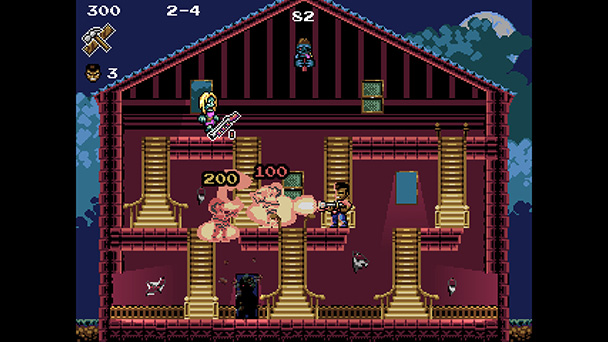
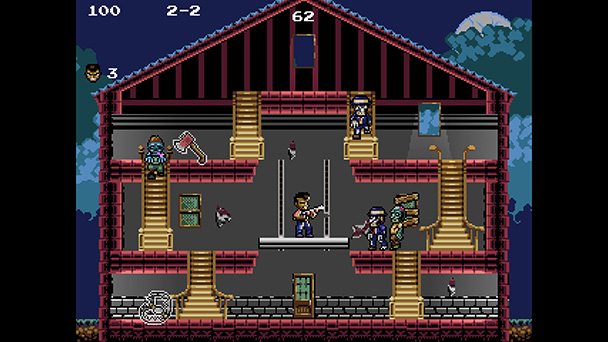
Combat is built around six distinct weapons, each with their own quirks and limitations. They’re fun to experiment with, especially early on, but their lengthy animations can become a liability. The game’s deliberately slow movement speed certainly doesn’t help matters. There are moments where you’ll commit to an attack only to realize you’ve trapped yourself in a slow-moving animation just as a new threat emerges. Sure, it generates some apprehension, but there’s also the sporadic bit of aggravation when a death seems unavoidable.
This frustration is amplified by enemy spawns. Some foes suddenly emerge from windows, catching you off-guard in a way that feels cheap rather than signaled. The game’s dynamite-tossing maniac is particularly aggravating. He’ll lob explosives into your path with just enough unpredictability to break your rhythm. Combined with a rather sluggish movement speed for the protagonist, death doesn’t always feel like a punishment for a bad decision; sometimes it’s arbitrary. And that’s what keeps Living Dead House from earning a place in the single-screen pantheon.
Electrocuting The Dead
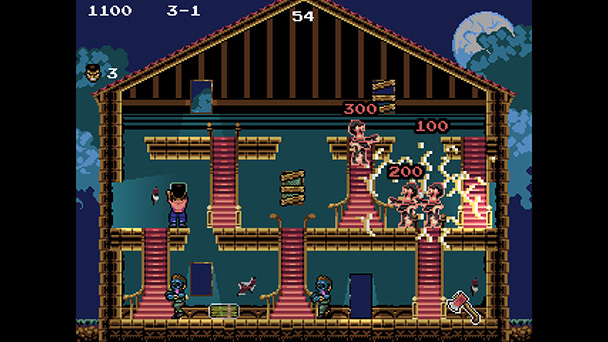
Still, the game isn’t without a couple of clever mechanics. Environmental hazards play an important role, allowing you to use the stage itself as a weapon. Whether it’s triggering traps or maneuvering enemies into dangerous zones, there is satisfaction in letting an ensnarement do the work for you, especially when triggering a booby trap kills multiple opponents. Likewise, a well-timed axe swing or strategically placed bear trap can slaughter two zombies and pulling this off feel like scoring a Tetris.
Living Dead’s level design also offers a few gimmicks. Some stages incorporate elevators that provide a quick escape from a horde of pursuing opponents, while others use Pac-Man-style tunnels that let you warp from one side of the stage to the other. These devices help to keep the gameplay from becoming too repetitive and encourage you to toy with the brain-eating mobs. Likewise, collecting the letters S-H-R-E-D or score-boasting bonus items pushes you into riskier situations.
Better Together
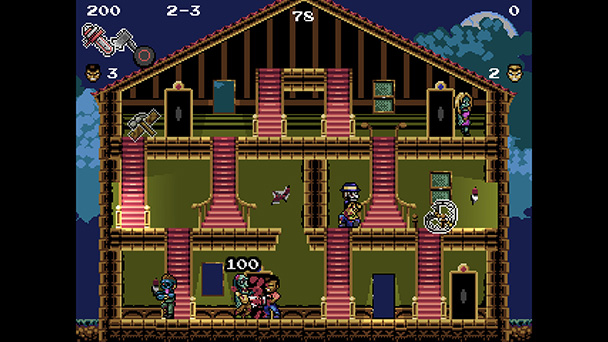
Where Living Dead House shines most is in its cooperative play and survival mode. Playing with another person diminishes some of the game’s frustrations, as you are you partner coordinate an assault on the undead. Meanwhile, Survival mode plays to the game’s strengths, challenging you to persist as long as you can on the game’s twenty different stages, potentially earning a place on the leaderboard.
Living Dead House’s innovations would have made it one of the more experimental coin-ops, had it actually been released during the ‘80s. While its ideas don’t quite come together cleanly enough, there’s more than enough quirk and charm to justify the game’s economical price.
Living Dead House was played on PC with review code provided by the publisher.
GAMEPLAY – 75%
CONTROLS – 65%
CONTENT – 70%
AESTHETICS – 70%
ACCESSIBILITY – 70%
VALUE – 80%
72%
GOOD
Living Dead House feels like a lost ’80s arcade oddity with some clever survival ideas. But its slow movement speed and occasional cheap deaths keep it from becoming truly addictive. It’s more fun with a friend, but even with a partner, don’t expect it to dethrone the classics.
User Rating:
4.2
( 1 votes)