
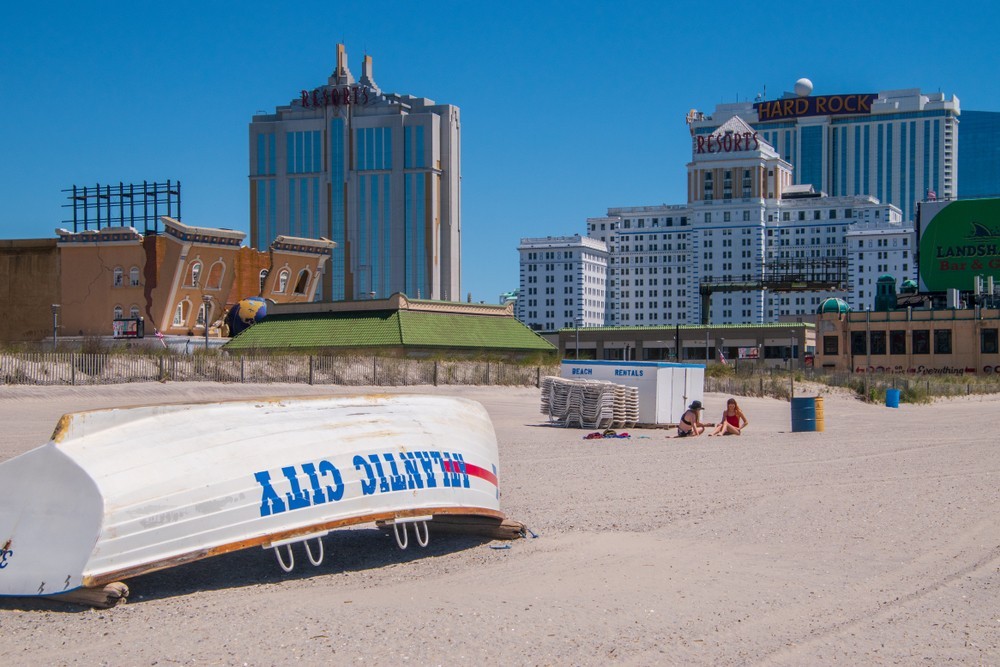
Atlantic City is facing a crisis. Three casino licenses have been awarded for New York City, a core market for A.C.
It is not the first time Atlantic City has faced new competition. The first real challenge came in 1992 when Foxwoods opened in Connecticut. Until 1992, Atlantic City was the only place to legally place a bet in the eastern half of the United States. For its first 14 years, Atlantic City shared the nation’s gamblers only with Nevada. Illegal gambling existed and there were fledgling Indian bingo operations, but nothing that cut into either Atlantic City or Las Vegas’s business.
Foxwoods was the first in a long string of legal casinos that opened in the East. However, none of those early operations posed a serious threat to the Boardwalk, or the Strip for that matter. For A.C., that changed in 2007, when Pennsylvania first legalized gambling. Pennsylvania started just with slot machines, but that was enough to cause pain in New Jersey.
Gambling in Pennsylvania started slowly. The first year the gross gaming revenue (GGR) from slot machines was just $500 million. The next year GGR hit $.14 billion and $2 billion the year after. In 2010, the state added table games and in 2017 authorized an additional 10 mini casinos and online gambling. Year over year revenue continues to grow at a slow, but steady, pace. However, since the pandemic, revenue has grown dramatically, from $4.1 billion in 2021 to $6.8 billion in 2025. A significant portion of the GGR from Pennsylvania came at the expense of casinos in New Jersey.
Prior to 2006, over 50 percent of the customers to the Boardwalk casinos came from the Keystone State. And by 2007, the casinos that had popped up in other jurisdictions were also taking a bite out of Atlantic City. Of course, 2007 was also the beginning of the Great Recession. By 2014, Atlantic City had hit rock bottom, only seven casinos surviving the crisis. The future of gaming in Atlantic City was uncertain — until sports and igaming were legalized. Igaming and mobile sports wagering saved the day. The revenue from those two now exceeds the casino revenue and continues to grow.
In 2006, the casinos in Atlantic City were cavalier about slot machines in Pennsylvania. Casino managers thought slot machines could not possibly compete with full casino resorts like those in Atlantic City. “What, me worry?” they said. Of course, they were wrong, very wrong. Twenty years later, faced with casinos in New York City, the attitude is different.
New Jersey has a new governor, Mikie Sherrill. Governor Sherrill has an unusual set of qualifications. She is a Navy helicopter pilot and has a Master’s degree from the London School of Economics and a law degree from Georgetown. Sherrill is also a two-term member of the U. S. House of Representative. Thus, Governor Sherrill has a background in finance, law, and government. She hit the ground running. One of her first statements concerned Atlantic City. She directed state lawmakers to get together and resolve the smoking ban dispute.
Last week, Governor Sherrill took the New York bull by the horns. She said the Atlantic City economy needs to be strengthened to help withstand casinos in NYC. It is a Christie-like move. In the wake of the Great Recession and slots in Pennsylvania, then-Governor Chris Christie stepped in to help. He demanded changes in regulation and helped find financing for the under-construction Revel. In retrospect, A.C. could have done without Revel, but it did inject new energy into the city. Sherrill is hinting at something as significant now.
There is time; the resorts in New York City are probably five years away. That gives Atlantic City time to plan and do something. The Casino Association of New Jersey responded immediately. The president, George Goldhoff, said the industry is ready and willing to contribute. That puts the casino industry of Atlantic City of 2026 light years ahead of the industry in 2006. Still, it is a challenge of gigantic proportions.
The first steps are easy, recognizing the problem and then setting up a mechanism for planning. The next step is much harder, deciding what to do. The execution will be easier than the planning.
The question the people in New Jersey have to ask is the same that every jurisdiction must ask. What can we do to offset new competition located closer to the customer, indeed in the customers’ home? At the turn of this century, Atlantic City was the primary provider of casino gaming to nearly 60 million people. Atlantic City was but a short drive for those people. Now, there are nearly 75 casinos serving that same population. And it gets worse.
Connecticut, Delaware, New Jersey, Pennsylvania, and West Virginia have online casino gambling: stay and play at home. What does it take to pull customers from those closer-to-home options? That is a question that mall operators were asking in the 1950s; the only answer was to offer significantly more than the closer options. That is hardly a possibility for casinos in Atlantic City. The licensees in New York City will spend $15 billion to $20 billion building three resorts. The new resorts will be the newest and best with all of the latest bells and whistles.
Governor Sherrill suggests that Atlantic City needs to be safe, clean, and welcoming. That is the minimum. Add to that list up to date, but that is difficult. The corporations with operations in Atlantic City will have to choose where to invest in the future. Atlantic City is not likely to be as attractive as other jurisdictions with less competition and a better return. Atlantic City needs a magic act, something to turn the Boardwalk back into a place to relax, take a vacation, put your toes in the ocean, eat a fine meal, and play a hand of blackjack. It is a tall order, but there is time. Good luck, guys!