

Hello and welcome to another great installment of ‘why would you want to game on that?’ where I try to play PC games on something that’s not really designed for it. This time, it’s the MacBook Neo, Apple’s low-cost ($599/£599) laptop that runs on the processor from an iPhone 16 Pro. As such, it has six cores, only two of which are ‘performance’ cores, as well as a five-core GPU and just 8 GB of RAM.
All of that sounds like we’re going to be in for a poor gaming experience here, and if you’re expecting 4K and ray-tracing you’re out of luck. However, it’s possible to get a lot of games to run on this little machine, and surprisingly successfully too. Not only does it run a selection of titles from Steam, but there are games all over Apple’s App Store, and it will run iPad and iPhone games too.
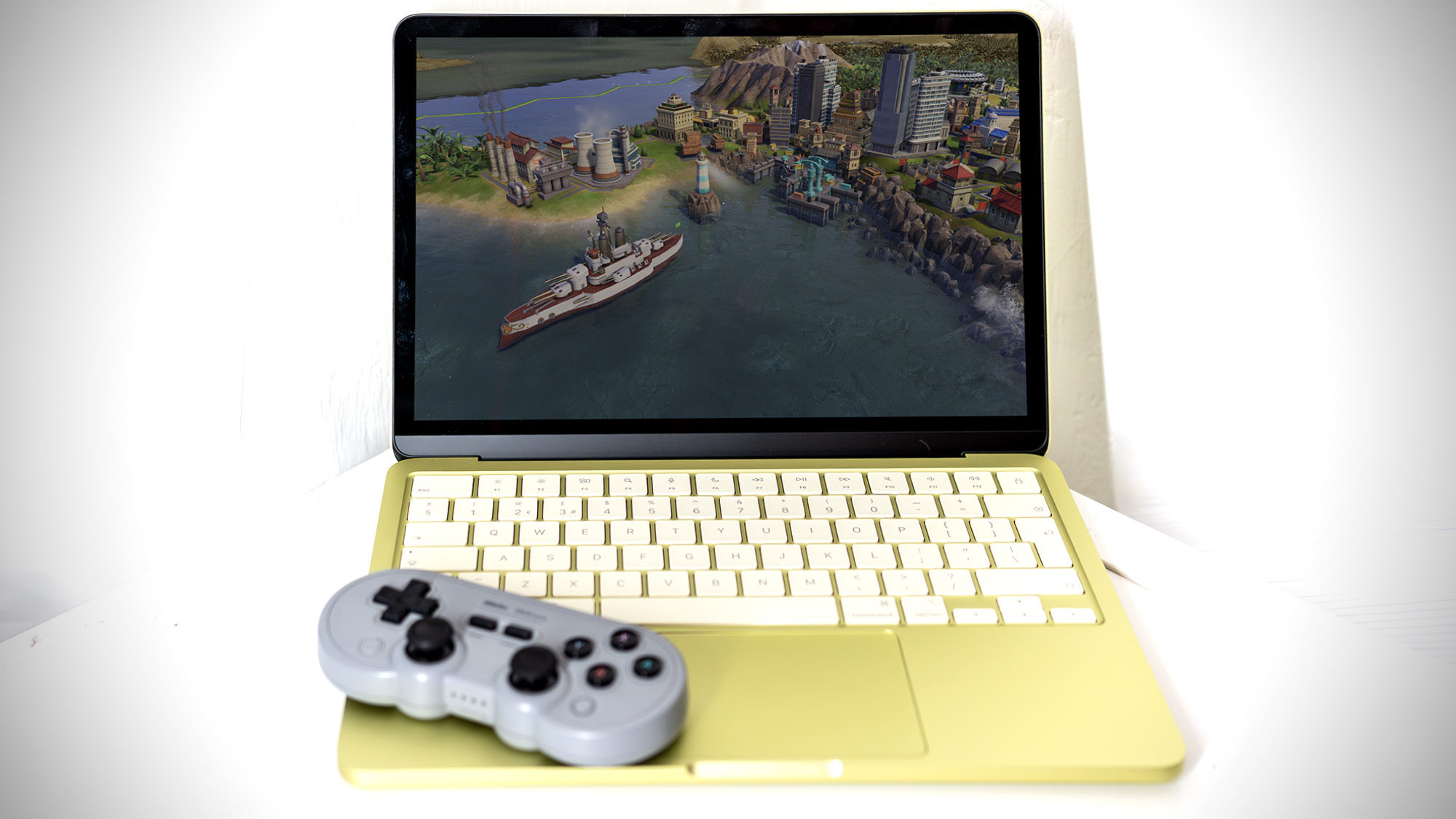
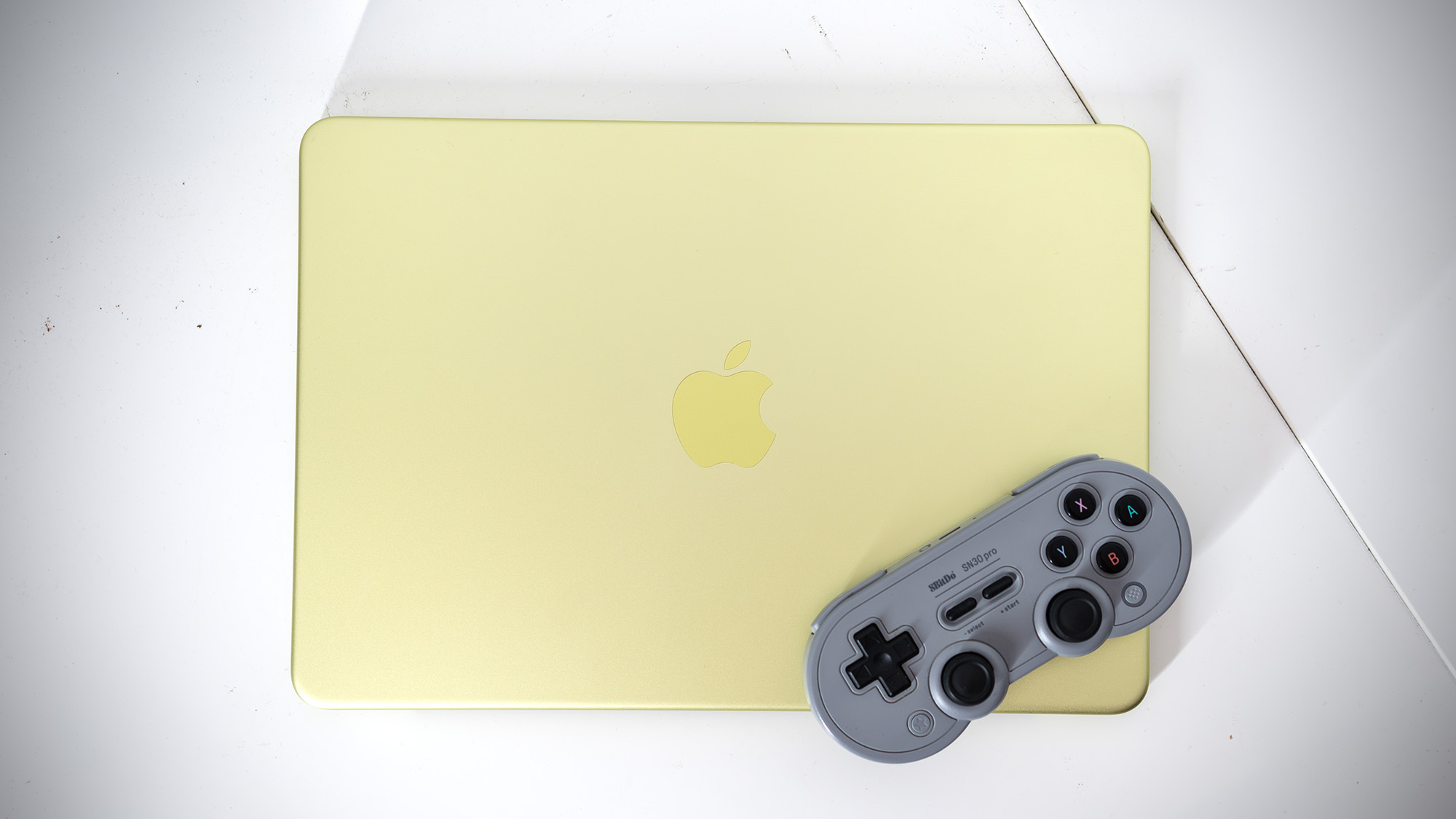
On the outside, the MacBook Neo looks like a standard compact laptop: the one I’ve got here is bright metallic green—called ‘Citrus’—but there’s a nice ‘Indigo’, a pinky ‘Blush’, and plain old silver available too. It has a 60 Hz, LED-backlit, IPS screen and a battery that will last all day.
Swipe to scroll horizontallyNeo specs
CPU
Apple A18 Pro
NPU
Apple Neural Engine
Graphics
integrated, five cores
Memory
8 GB
Storage
256 GB SSD (512 GB also available)
Screen size
13-inch
Screen type
LED-backlit IPS
Resolution
2408 x 1506
Refresh rate
60 Hz
Ports
1x USB 3.2 Type-C, 1x USB 2.0 Type-C, 3.5mm audio
Wireless connectivity
Wi-Fi 6E, Bluetooth 6
Dimensions
127 x 297 x 206 mm
Weight
1.23 kg
Price
$599 | £599
Image 1 of 3
 (Image credit: Future)
 (Image credit: Future)
 (Image credit: Future)
Buy if…
✅ You’re an Apple fan looking for a cheap laptop: It’s never going to compete with dedicated gaming hardware, but if you want something that can play Stardew Valley alongside spreadsheets and presentations, this is a solid budget choice.
Don’t buy if…
❌ You want something that can actually play games: The Neo is too compromised to be a genuine gaming choice, and is better suited to reading excellent PC gaming websites in-between bouts of office work.
Elsewhere, the system’s roots in a smartphone make themselves apparent when you look at the ports on the side of the laptop. The iPhone 16 Pro had a single 10 Gbps USB-C port, and that’s present here too, joined by a USB 2.0 companion. Both ports can be used for charging, and the USB 3.2 is also a video output, so it’s easy to see the Neo spending its life with a charger in the slow port and a USB hub in the faster one. There’s no way to tell the ports apart before you’ve learned which is which, and even after that you’ll probably still mix them up, but the OS is clever enough to flash up a warning if you plug a USB 3.2 or Thunderbolt accessory into the wrong port.
The SSD is another obvious bottleneck for the Neo. A 256 GB drive just isn’t enough these days, and if you’ve already got it stuffed with productivity apps and streaming downloads, there’s not much room left for games unless you invest in one of the best external SSDs. You’re only looking at read speeds of 1,547 MB/s from the drive too, which is PCIe 2.0 speed. The iPhone 16 used a custom NVMe controller rather than UFS for its storage, so the Neo might be running the same thing here. And one final gripe: there’s no backlight on the keyboard.
How does it do in benchmarks? It’s not great, but it can run them. Wild Life Extreme is 3D Mark’s cross-platform graphics workout for phones and notebook PCs, and the Neo ran it at 23.3 fps. Things were looking good for the little laptop until I pulled out Steel Nomad, a much more demanding test. This saw the framerate drop to just 3.7 fps, though the benchmark software still told me this was ‘good’. You can get 90 fps out of Steel Nomad with the right RTX 5080 system, at which point it runs out of superlatives to tell you how amazing your PC is.
On to the games. Cyberpunk 2077 is a great benchmark, and the MacBook Neo can play it at 30 fps! The downside is that to get this, you need to dip below Steam Deck settings, using the Low graphics profile, with the resolution at 720p, and with MetalFX upscaling in performance mode. That’s not great, and looks a little soft thanks to all the upscaling going on, but at least it is technically playable.
Over in our old friend, Shadow of the Tomb Raider, medium settings are the order of the day. To get to 30 fps you need to reduce the resolution slider to 75% and turn on FidelityFX CAS, but the game plays in 900p and for a title that’s approaching ten years old looks pretty good.
It’s then that I hit a little bit of a problem. I really wanted to benchmark a Total War game, and while they install quite happily from Steam, both Warhammer III and Three Kingdoms do the same thing when they launch, which is nothing. The app seems to run, but no actual game appears beyond the launcher window. This is most odd, as the latest MacBook Pro can happily play Warhammer III at 50 fps.
Image 1 of 3
 (Image credit: Future)
 (Image credit: Future)
 (Image credit: Future)
Casting around for something else to test, my eye falls on Civilization VI, another ten-year-old title. At 800p, the Neo can squeeze 50 fps out of this game, which isn’t bad but it’s hardly a graphical colossus. Just for funsies, I installed the same game on an AMD Ryzen 5 7530U mini-PC that also costs £599 (though you’ll have to spring for a monitor and keyboard as well), and ran it using DirectX 12 at 820p, where it produced 34 fps. That’s got to be a big win for the Neo.
So is the MacBook Neo a serious gaming device? Hell no. Is it good enough for a few rounds of Civ in between typing sessions and video conferences? Yup. The fact that this 13-incher is built to Apple’s usual high standards, provides decent if decidedly low-end performance (its single-core score in Geekbench 6 is higher than that of some Ultra 9 chips, however)—and costs just $599/£599, remember—could well put the wind up some PC manufacturers.
Hopefully we’ll see a spate of copycats that use the stronger integrated graphics solutions we’re starting to see to make a generation of low-cost laptops that you really can play games on. Wouldn’t that be nice?
Best gaming laptop 2026
All our current recommendations
Apple MacBook Neo: Price Comparison