
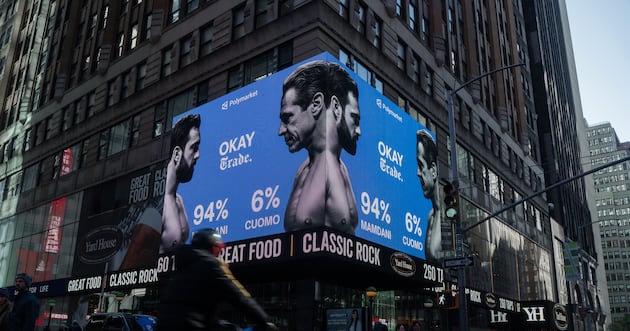
Two of the most popular prediction market platforms have implemented new policies to prevent athletes from trading on their sports and political candidates from trading on their own races.
But whether the rules can prevent that from happening remains to be scene.
Kalshi announced new “technological guardrails” to preemptively block politicians, athletes and others from trading in certain politics and sports markets. The company said those efforts have been in the works for months to address Commodity Futures Trading Commission guidance and federal legislation to prevent insider trading and market manipulation. The CFTC, which historically monitored futures contracts on things such as livestock, crude oil and gold and silver prices, regulates prediction markets.
A Kalshi spokesperson said in a statement that the new features “further demonstrate our commitment to safe markets.”
Polymarket, the world’s largest prediction market, also updated its rules regarding trading on stolen confidential information, illegal tips and by those who can influence the outcome. It would include athletes but could also include company officials, policymakers or anyone who would have enough influence to affect the outcome of an event or know the information in advance, according to the Associated Press.
“Markets thrive on clarity,” Neal Kumar, Polymarket chief legal officer, said in a statement. “These rule enhancements make our expectations abundantly clear for every participant across both platforms and highlight the compliance infrastructure we have already built. As Polymarket continues to scale, we will build on our foundation with clear communication to Polymarket’s users to ensure our markets do what they do best — surface truth.”
Kalshi and Polymarket have signed business partnerships with several sports teams and pro leagues in order to bolster credibility with sports fans.
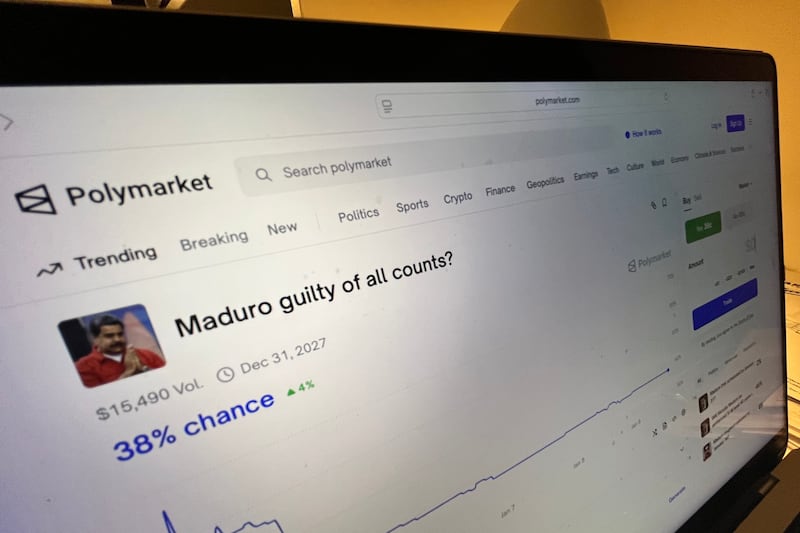 Polymarket prediction market website is displayed on a computer screen Friday, Jan. 9, 2026, in Philadelphia. | Wally Santana, Associated Press
Earlier this year, Polymarket faced intense criticism after some of its users made substantial bets ahead of the war in Iran and the military action in Venezuela, per AP. Users appeared to have profited from knowing in advance that President Donald Trump was going to take military action in those countries.
Will new rules stop athletes and politicians from betting on themselves?
I. Nelson Rose, an emeritus law professor at Whittier College and expert on gambling law, said those companies already ban athletes trading on their own sports in their terms and conditions, as do licensed sportsbooks. But there are ways around the rules.
“A lot of people I talked to who were sports bettors said, ‘Yeah, athletes don’t make the bets themselves. They get a friend or relative to make it for them.’ It’s really hard to police that,” he told the Deseret News.
And it’s not just sports “But with sports they obviously should not be allowing bets on the performances of individual athletes,“ Rose said.
“Athletes bet against themselves, right, underperforming. You don’t normally think that a candidate would bet that they’re going to lose. But maybe they know they’re going to lose and they figure, ‘Well, at least I can make some corrupt money out of this.’”
Rose said the underlying legal issue is whether Congress intended to legalize something that looks a lot like sports betting when it passed commodities exchange laws starting in the 1930s. He said what’s happening now shows it did not.
Prediction market companies are “absolutely” doing everything they can to stop federal legislation, Rose said. “And I’ll make my prediction that Congress won’t act on it,” he added, citing the Trump’s family involvement in the industry.
Trump’s son, Donald Trump Jr., has invested in Polymarket through his venture capital firm and is a strategic advisor for Kalshi.
“The problem for Kalshi and Polymarket is that they are losing public support. The problem for the country is that Donald Trump’s family has a financial interest in Kalshi and Polymarket,” Rose said.
Crackdown coming on prediction markets?
The new policies come as two more members of Congress introduced legislation aimed at prediction markets.
On Monday, Sen. John Curtis, R-Utah, and Sen. Adam Schiff, D-Calif., filed a bill to prohibit CFTC registered entities from listing any prediction contract that resembles a sports bet or casino-style game.
The bipartisan Prediction Markets Are Gambling Act clarifies that states can maintain their authority over sports betting and casino gaming.
“Too many young people in Utah are getting exposed to addictive sports betting and casino-style gaming contracts that belong under state control, not under federal regulators,” Curtis said in a statement.
Schiff said sports prediction contracts are sports bets with a different name, and violate state and federal law.
“Rather than enforce the law, the CFTC is greenlighting these markets and even promoting their growth. It’s time for Congress to step in and eliminate this backdoor which violates state consumer protections, intrudes upon tribal sovereignty and offers no public revenue,“ he said in a statement.
At least three other bills regarding the industry are pending in Congress, including a bipartisan measure cosponsored by Utah Republican Rep. Blake Moore.
What Americans know about prediction markets
A new Ipsos poll for the American Institute for Boys and Men found 21% of Americans have heard of prediction markets and 3% use them.
Among those who have heard of them, 91% overall and 88% of young men view purchasing event contracts on prediction markets as financially risky, on par with investing in cryptocurrency and placing a sports bet.
The survey found 6 in 10 Americans believe prediction markets are closer to gambling than to investing.
Also, 59% say regulating prediction markets like gambling is a good idea, while 52% say regulating it like financial investing is a good idea. The options were good idea, bad idea or not sure.
Utah has aggressively pushed to keep Kalshi and Polymarket out of the state. Gov. Spencer Cox recently signed legislation that would expand the state’s definition of gambling to include what are known as “prop bets,” wagers on specific events or player performances within a game that are not directly tied to the final score or overall outcome.
Rose said it is states, not the federal government, that decide what forms of gambling are legal inside their borders.
“Utah should not be forced to accept sports betting. Even Nevada has filed suit, because there is no experienced federal regulator overseeing this new form of gaming and nothing like the background checks and safeguards Nevada imposes on its licensed sportsbooks,” according to Rose.
“And, of course, an unlicensed operator accepting bets across state lines on elections and sports events is unlawful under federal laws and the laws of every state.”
A new Utah poll found residents of the state are more aware of prediction markets than Americans overall.
The Morning Consult survey for the Deseret News and Hinckley Institute of Politics found 31% of Utahns are very or somewhat familiar with prediction markets, while 59% are not. Among 18- to 34-year-olds, however, a plurality of 46% are familiar.
Only 12% have used a prediction market at least once, though it rises to nearly a quarter of 18- to 34-year-olds. Interestingly, a slightly higher percentage of people in that age group consider it gambling compared to those in older age groups.
Men are more than three times as likely as women to have used one.