
The war in the Mideast hasn’t affected consumer visitation to Las Vegas casino resorts yet, but if the conflict is prolonged it could result in an unexpected slump in leisure travel, two gaming analysts said Thursday.
John DeCree, the head of institutional investor research at Las Vegas-based CBRE Capital Advisors, and Barry Jonas, a gaming analyst with Atlanta-based Truist Securities, said Southern Nevada’s track record for reinvention during crises should prepare it to weather the geopolitical storm brewing from the continuing conflict between the United States and Israel with Iran.
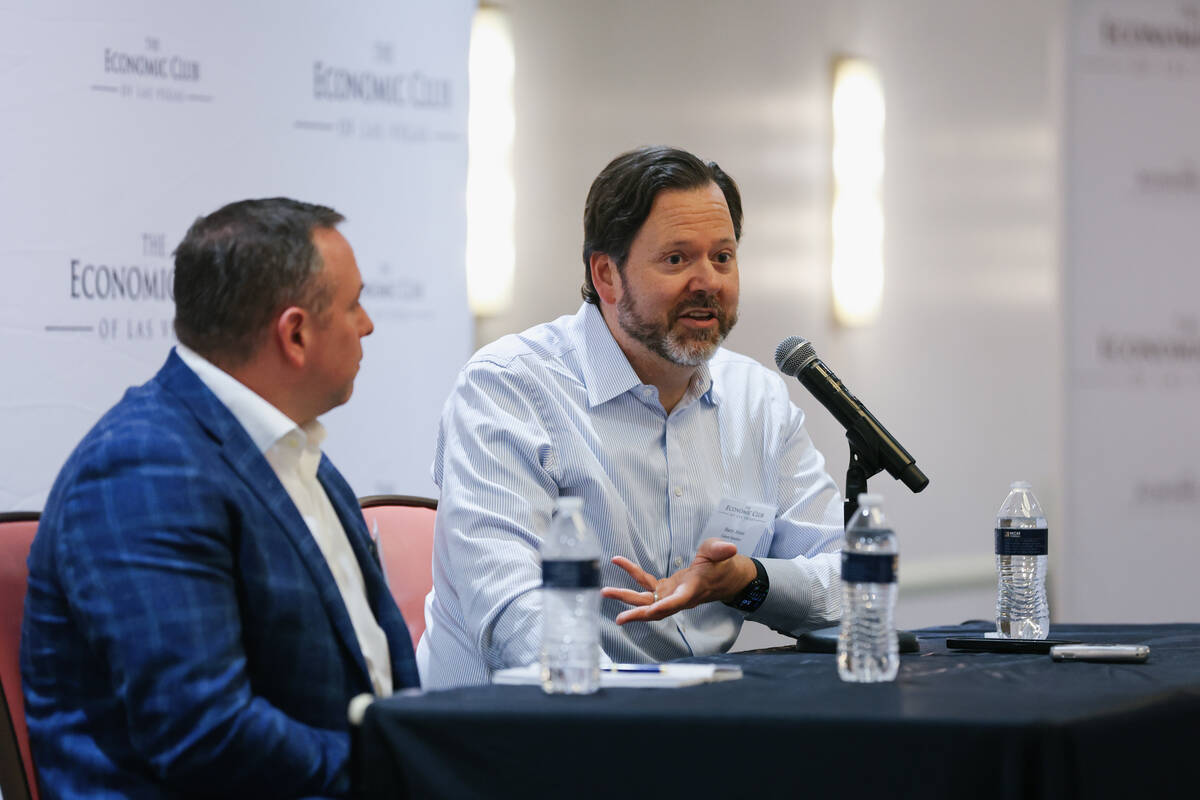
DeCree and Jonas gave their analysis during a two-hour panel and meet-and-greet sponsored by Economic Club of Las Vegas at Park MGM.
“To start with the war, so much of it right now is going to be consumer sentiment,” DeCree said. “How does that consumer feel? Do they feel like they want to hop on a plane or get in a car and drive to Las Vegas and splurge? I think we’ve been dealing with global issues pretty regularly, all to varying degrees of magnitude.
“And my perception is the consumer in the U.S. is resoundingly resilient and likes to spend money and likes to spend money on experiences,” he said. “I think at the current moment, we’re still seeing the consumer behavior similar, if not the same since the war in Iran has started. That could change certainly the longer that it persists, the degree of magnitude of which things escalate.”
DeCree suspects resorts would be able to get an early warning of approaching downturns by closely monitoring short-term bookings.
“If you had a trip planned 60 or 90 days out, you’re probably not canceling that trip just yet,” he said.
Low-end customers affected
Jonas added that resorts would most likely see the downturn from its low-end customers and not the high end.
“When gas prices are low, that’s very helpful for casinos,” Jonas said. “When gas prices are high, it’s not a completely linear relationship. There would be a period of time where (casinos) will just absorb it. If you’re spending $600, $800 a night, spending an extra $50 or $60 on gas to come from California is probably not a deal breaker. That low to mid-end is really feeling the brunt of that uncertainty and the brunt of inflationary pressures.”
The newest challenge to Southern Nevada resort companies now is providing attractions that are affordable to low-budget visitors.
“It does seem like a lot of the entertainment that has been developed in Las Vegas caters to the higher end,” DeCree said. “A Knights game at T-Mobile (Arena) is not particularly inexpensive. You’re talking $150 a ticket.
“Barry’s family’s coming out in a couple weeks, and, you know, to take a family of four or five to see the Las Vegas Sphere is quite expensive. So I think when we look at mid-value-oriented properties, lower income levels, there’s a little bit less to do in Las Vegas perhaps than there used to be. And so I think Vegas is great at reinventing itself, and I think some of the companies that have exposure to these assets are working on ways to better appeal to that customer segment. That high-end customer segment drives so much revenue and cash flow that we often can forget about that segment or not pay as much attention to it until we realize it’s, you know, 7 percent, 8 percent or 10 percent of visitation. Let’s find a way to get that customer back.”
Deconsolidation?
Jonas and DeCree also talked about the prospect of some of the largest Las Vegas operators selling some of their assets in the future because they’ve found they no longer need a high number of resort properties to be profitable.
“I think most executives would say we don’t need to have so many properties,” Jonas said. “When Caesars got rid of the Rio, I would say the bulk of that (cash flow) they kept in-house.
“MGM has divested certain regional assets. I think that there are instances where you need to focus on your strategy and things evolve. When deals were initially made, properties initially developed, there probably were only a handful of competitors within three hours and that has evolved.”
Contact Richard N. Velotta at rvelotta@reviewjournal.com or 702-477-3893. Follow @RickVelotta on X.